
- The Vera C. Rubin Observatory has officially begun its cosmic survey, which will last for the next 10 years.
- This historic telescope is set to create ‘the greatest cosmic movie ever made’ as it embarks on an unprecedented survey of the universe.
- Equipped with the world's largest digital camera, the observatory will capture hundreds of images each night, mapping billions of stars and galaxies.
- The observatory, located in northern Chile, will capture images every 40 seconds at night, creating a time-lapse panorama of the cosmos.
- The project, known as the Legacy Survey of Space and Time (LSST), aims to uncover new insights into dark matter and dark energy.
- The observatory is jointly funded by the US National Science Foundation and the Department of Energy, with a budget of $800 million.
- The observatory's team anticipates dispatching about 7 million alerts each night to flag interesting astronomical phenomena.
- The observatory is named after Vera Rubin, who provided early evidence of dark matter's existence in the universe.
The Vera C. Rubin Observatory in Chile has officially commenced its 10-year cosmic survey, known as the Legacy Survey of Space and Time (LSST), aiming to capture the southern sky with the world's largest digital camera.135
This state-of-the-art facility, perched at an altitude of 8,800 feet on Cerro Pachón, will take hundreds of images every night, creating a time-lapse panorama of the universe.
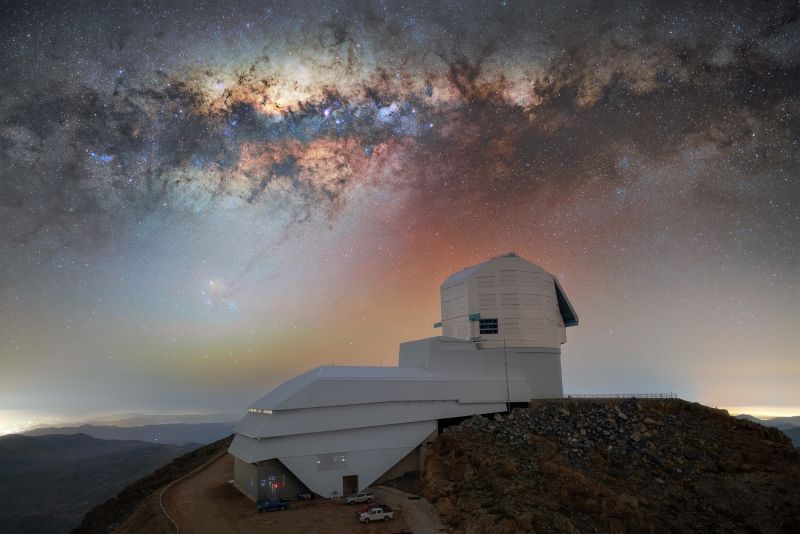
According to Brian Stone, acting director of the US National Science Foundation, “Today, we begin filming the greatest cosmic movie ever made.” The observatory's camera, weighing 6,600 pounds, will capture detailed images every 40 seconds, allowing scientists to explore phenomena such as pulsating stars, supernovae, and the elusive dark matter and dark energy.
The project is expected to generate around 7 million alerts nightly, flagging interesting cosmic events. Phil Marshall, the observatory's deputy director of operations, stated, “We're going to see large numbers of scientists across the world working with this data set, studying the universe in a way that they haven't been able to before.” The Rubin Observatory is jointly funded by the US National Science Foundation and the Department of Energy, with a total investment of $800 million.67
Researchers anticipate that the LSST will provide crucial insights into how galaxies form and cluster over billions of years, potentially reshaping our understanding of the universe's evolution.
“The Vera C. Rubin Observatory has officially launched its 10-year cosmic survey, utilizing the world's largest digital camera to capture the southern sky. Scientists anticipate uncovering new insights into dark matter, dark energy, and the formation of galaxies.”
 news.cgtn.com



