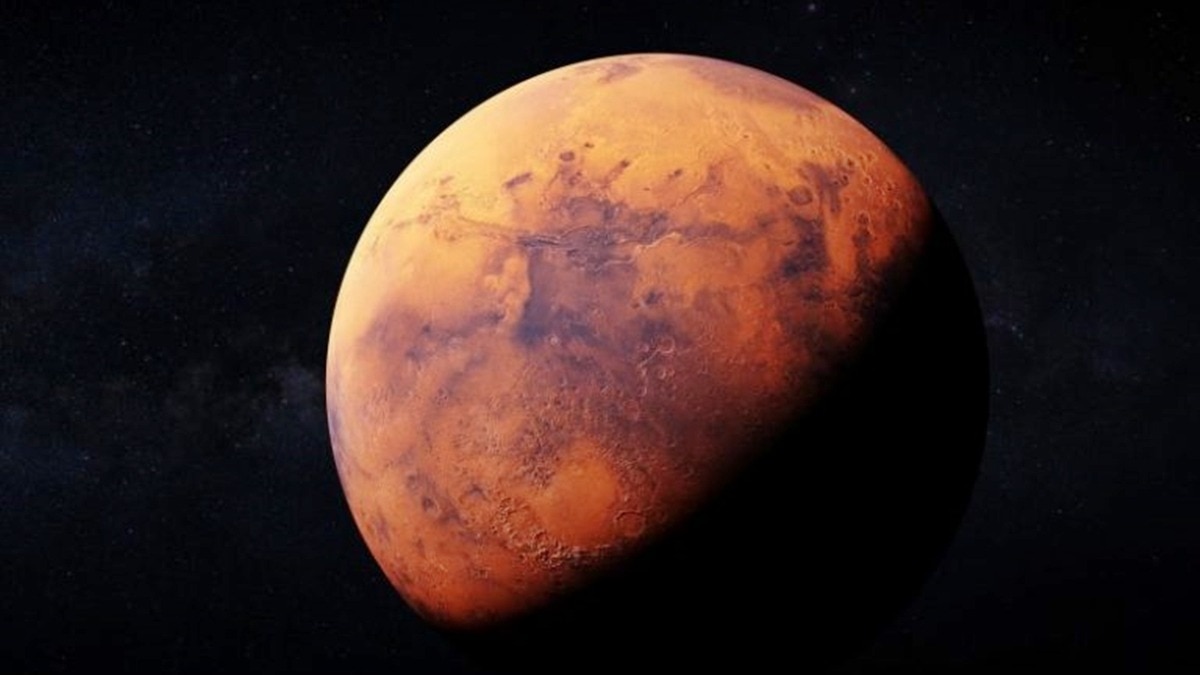
- Solar wind is steadily stripping away Mars' atmosphere, according to a new study, which helps explain the planet's transformation and raises questions about future human exploration.
- The study, led by Boston University, reveals how the solar wind continuously strips away Mars' atmosphere, contributing to its current cold and dry state.
- Unlike Earth, Mars lacks a strong global magnetic field to deflect the solar wind, allowing charged particles to directly impact its atmosphere.
- The study identifies Kelvin-Helmholtz waves as a key mechanism driving atmospheric ion escape, primarily observed on one side of Mars depending on the solar wind's electric field direction.
- Using simultaneous observations from Nasa's MAVEN and China's Tianwen-1, scientists linked solar wind conditions to atmospheric particles escaping from Mars for the first time.
- The findings indicate that atmospheric loss is not uniform across Mars, occurring mainly on one side of the planet based on the solar wind's electric field direction.
- Elon Musk's vision of making humanity a multi-planetary species by settling Mars is challenged by the ongoing atmospheric loss due to solar wind.
- The study's implications extend beyond Mars, suggesting that similar atmospheric erosion could occur on other planets without strong magnetic fields.
- As NASA's MAVEN mission approaches its final phase, the upcoming ESCAPADE mission will continue to investigate how the Sun shapes the Martian environment.
A new study led by Boston University has uncovered that the solar wind is steadily stripping away Mars' atmosphere, a process that could hinder future human exploration efforts. Unlike Earth, Mars lacks a strong magnetic field, allowing solar wind particles to directly impact its atmosphere.12
Researchers liken the atmospheric loss to waves rippling across a lake, where solar wind generates Kelvin-Helmholtz waves that stir up plasma clouds, facilitating atmospheric escape. This phenomenon was observed using data from NASA's MAVEN and China's Tianwen-1 missions, marking the first time conditions in the solar wind were directly linked to atmospheric loss on Mars.45

Lead author Chi Zhang stated, “We provided clear evidence that these plasma clouds are generated by Kelvin-Helmholtz waves.” The study found that atmospheric loss is not uniform; it occurs primarily on one side of Mars, depending on the solar wind's electric field direction.

The bursts of atmospheric loss observed were significantly more intense than previously known escape channels, with estimates showing 1 million to 100 million ions escaping through every square centimeter each second. This raises questions about the long-term habitability of Mars, a concern for future explorers like Elon Musk, who envisions a multi-planetary human presence.
As NASA's MAVEN mission approaches its conclusion, the upcoming ESCAPADE mission aims to further investigate how solar activity shapes the Martian environment, providing critical insights into the planet's atmospheric evolution and potential for human colonization.9
“Using simultaneous observations from NASA's MAVEN and China's Tianwen-1 spacecraft, the Boston University-led team directly linked incoming solar wind to escaping Martian ions for the first time. The plasma clouds trigger a 'bulk escape' of ions, mostly on one side of the planet depending on the solar wind's electric field direction.”
 StudyFinds



