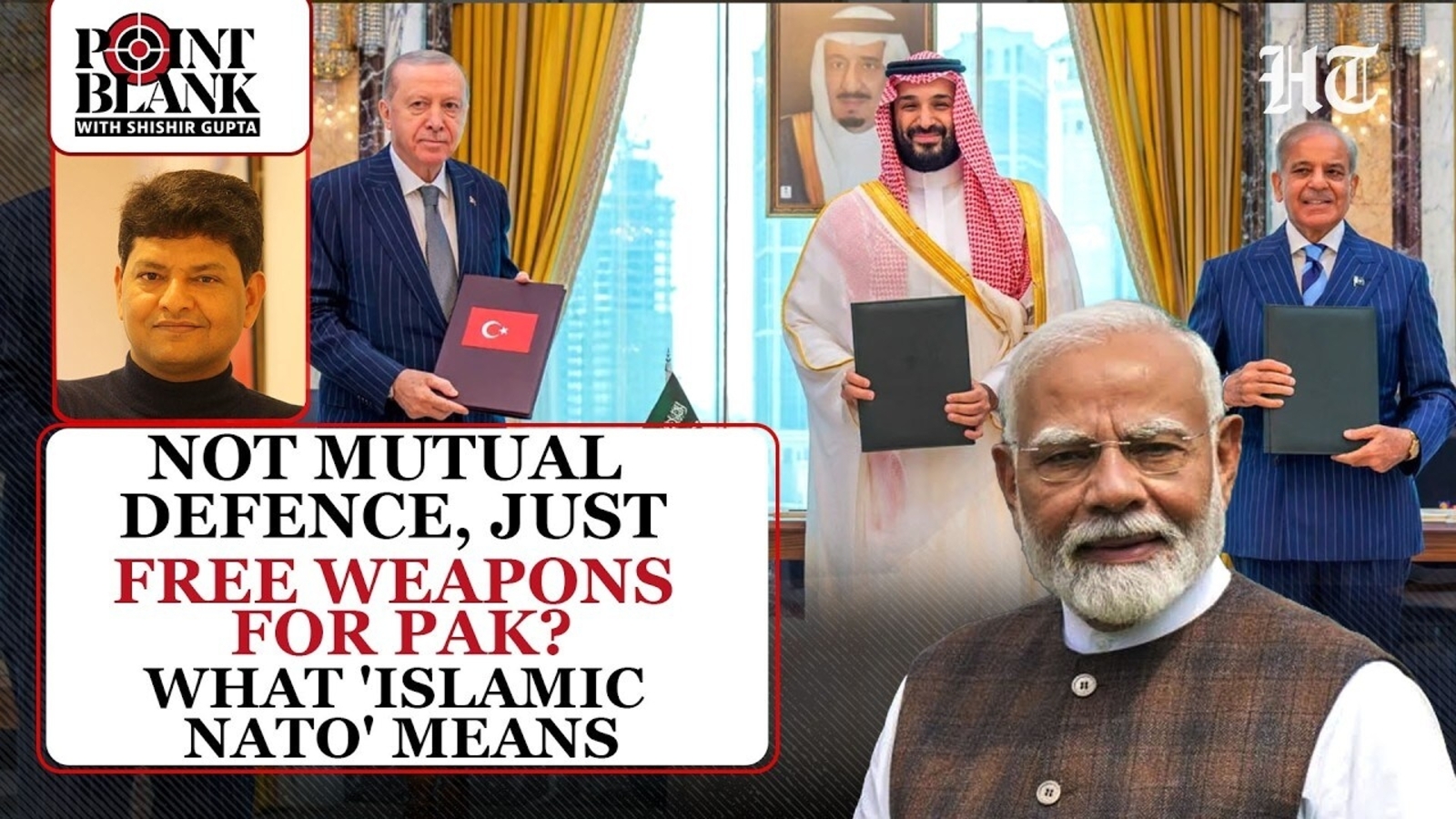
- The Mecca Joint Defence Agreement is signed by Saudi Arabia, Türkiye, and Pakistan, sparking a major debate across West Asia and South Asia.
- The pact is presented as a NATO-style mutual-defence arrangement, where an attack on one member would be regarded as an attack on all.
- Analyst Gupta discusses the pact's political, military, and religious meanings in a conversation with senior anchor Aayesha Varma.
- Gupta cautions against accepting the pact's public description at face value, emphasizing the gap between rhetoric and action.
- The credibility of the pact is questioned, with the central concern being whether members would actually fight for each other.
- India's concerns are particularly focused on Pakistan's potential access to money, defence supplies, and technology as a result of the pact.
- The agreement appears to mirror NATO’s Article 5 principle of collective defence, raising questions about its actual implementation.
- Gupta argues that the true significance of the pact will depend on how its members act during a military crisis.
- The symbolism of the pact is significant, as it is framed around Sunni-majority states and located in Mecca.
- Gupta highlights that the Sunni-Shia divide shapes West Asian security, particularly the rivalry between Saudi Arabia and Iran.
- The potential for future participants in the pact could include Arab states like Egypt, Kuwait, Bahrain, and Qatar.
- Gupta warns that it is too simplistic to conclude that the pact is primarily directed at Iran.
- The credibility of mutual-defence commitments relies on their ability to impose real costs on members, as seen in NATO's structure.
- Gupta points out that previous regional partners have offered limited support to Saudi Arabia after attacks, rather than decisive military action.
- The Mecca Defence Pact is viewed as an emerging geopolitical signal rather than a proven military alliance.
- Gupta suggests that the pact could provide Pakistan with greater access to money, defence supplies, and military technology.
- Turkey's defence relationship with Pakistan includes cooperation in unmanned systems and submarine modernisation.
- The Saudi-Turkish-Pakistani framework could allow Pakistan to rebuild inventories and expand its missile or drone capabilities.
- India is likely to assess the pact through the lens of Pakistan's involvement and Turkey's pro-Pakistan stance.
- Turkey's participation in the pact adds complexity due to its existing obligations as a NATO member.
- The Mecca arrangement cannot be seen as a backdoor route to NATO protection for Pakistan.
- Gupta highlights that Pakistan's nuclear status makes this emerging arrangement more consequential than a conventional defence partnership.
- The wider Middle East already contains multiple layers of deterrence and insecurity, complicating the regional dynamics.
- India's expanding partnerships with various countries offer it diplomatic and strategic options in response to the pact.
The Mecca Joint Defence Agreement between Saudi Arabia, Türkiye, and Pakistan is framed as a NATO-style mutual-defence pact, where an attack on one member is considered an attack on all. This arrangement has ignited significant debate across West Asia and South Asia, raising questions about its implications.191016
The pact is seen as politically, militarily, and religiously significant. Turkey, a NATO member, contributes military-industrial capabilities, while Saudi Arabia offers financial resources and the custodianship of Islam's holiest sites. Pakistan adds one of the largest armed forces in the Muslim world, including nuclear capabilities. This combination gives the pact a powerful symbolic profile.320
However, experts urge caution. The true significance of the agreement will depend on the actions of its members during a military crisis. Gupta emphasizes that mutual-defence commitments are credible only when they impose real costs on their members, unlike previous instances where regional partners provided limited support to Saudi Arabia after attacks.8
The pact's location in Mecca and its framing around Sunni-majority states suggest a religiously infused security grouping, potentially inviting future participants like Egypt and Qatar. Yet, the Sunni-Shia divide complicates the regional security landscape, particularly the rivalry with Iran, which maintains extensive relationships with various groups across the region.1112
Ultimately, the central question remains: would Saudi Arabia, Turkey, and Pakistan actually fight for each other?5
“Analyst Gupta argues the pact's true significance will depend on whether members act in a real crisis, noting that NATO's Article 5 works because of decades of coordination and US capability. He also highlights Pakistan's nuclear status and A.Q. Khan legacy as a source of international concern, even without evidence of nuclear cooperation.”




