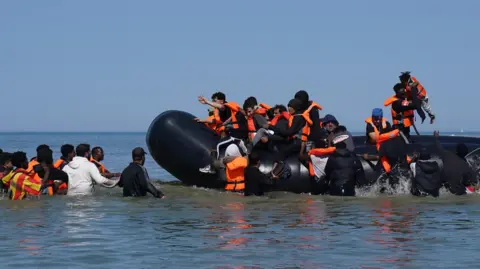
- Reform UK insists that using the Navy to stop migrant boats would be legal, despite criticism from France regarding potential violations of French sovereignty and international law.
- Reform UK announced plans to intercept boats crossing the English Channel and return migrants to French ports, even if France disagrees, using military-crewed inflatable boats from 10 Navy patrol vessels.
- Under the plan, Border Force officers and police would arrest individuals on the boats, returning them to France or Belgium with the help of Navy personnel or Marines; a Bay Class landing ship would provide detention capacity at sea for up to 700 people.
- Zia Yusuf, Reform's home affairs spokesman, stated that if the Elysee Palace refused cooperation, His Majesty's Royal Marines would disembark migrants safely on the shore they left that morning.
- Reform UK claims that their humanitarian missions do not violate maritime or international law, citing UNCLOS obligations to assist those in danger at sea.
- Andrew Serdy noted that the proposals would require France's agreement, while James Turner KC stated that UNCLOS does not allow the UK to collect asylum seekers and return them to their departure state.
- Opposition parties have labeled the plan unworkable, with a Labour minister suggesting it would lead to "a lot of time arguing with France".
- Home Office figures indicate that migrant crossings this year are down approximately 43% compared to the same period in 2025.
Reform UK insists its plan to use the Royal Navy to intercept migrant boats in the English Channel is legal, despite strong opposition from France. The party's home affairs spokesman, Zia Yusuf, stated that if France refuses to accept disembarked migrants, the Royal Marines will return them to French shores.1245
The proposal involves deploying military-crewed inflatable boats from 10 Navy patrol vessels to intercept and return migrants. Border Force officers would arrest individuals on board, with a Bay Class landing ship providing detention capacity for up to 700 people at sea.3
Reform UK argues that their actions would comply with the United Nations Convention on the Law of the Sea (UNCLOS), which mandates states to assist individuals in peril at sea. A spokesperson emphasized, “Humanitarian missions do not violate maritime or international law.”
However, legal experts like Andrew Serdy and James Turner KC caution that the plan may not be feasible without French agreement, as UNCLOS does not permit returning asylum seekers without consent. Opposition parties have labeled the plan as unworkable, with Labour's minister suggesting it would lead to prolonged disputes with France.67
Home Office figures indicate that crossings have decreased by approximately 43% compared to the same period in 2025, raising questions about the necessity of such measures.
“France’s interior ministry said the plan would violate French sovereignty, the law of the sea and international law, while Home Office figures show Channel crossings are down about 43% versus 2025. International-law experts, including James Turner KC, argued UNCLOS does not entitle the UK to return asylum seekers to France without its agreement.”

 BBC
BBC