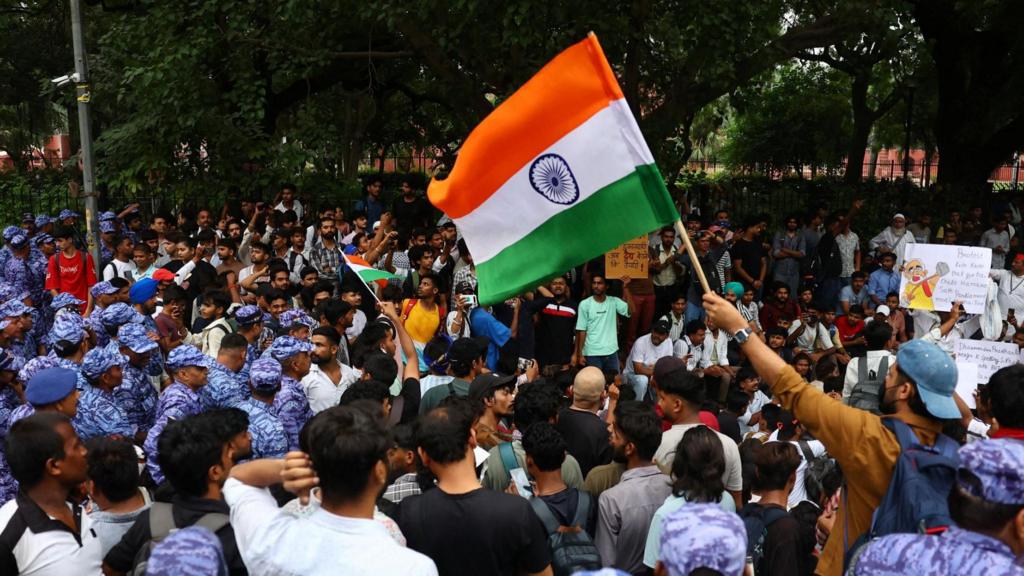
- Thousands of people are in the centre of India's capital Delhi for a protest called by the Cockroach Janta Party (CJP) demanding reforms to the education system.
- The protesters are demanding the resignation of Education Minister Dharmendra Pradhan and reforms to the examination system.
- Police clashed with protesters near parliament as they attempted to breach security barricades, marking one of the most serious confrontations in the movement's campaign.
- Several protesters who allege they were injured after being baton-charged by the police are receiving medical assistance at the protest site.
- Congress president Mallikarjun Kharge described the police baton charging protesting students as 'an attack on democracy'.
- Despite the crackdown, many protesters continued marching toward Parliament in small groups.
- The movement adopted the name 'cockroach' after a senior judge used the term to describe young people, turning it into a symbol of resilience.
- Tens of thousands of protesters have gathered in central Delhi, marking one of the biggest public displays of dissent against Prime Minister Narendra Modi's government in recent years.
- Delhi Police stated that the march had not been authorized and that restrictions were needed to maintain law and order around Parliament during the monsoon session.
- Supporters of the Cockroach movement have drawn support from opposition parties, rights activists, and some Bollywood celebrities.
Thousands of protesters from the youth-led Cockroach Janta Party (CJP) gathered in Delhi, demanding the resignation of Education Minister Dharmendra Pradhan and reforms to the education system. The protests, which began at Jantar Mantar, escalated as demonstrators attempted to march towards Parliament.1
The CJP, formed in response to anger over exam paper leaks, adopted the name 'cockroach' after a senior judge's derogatory remark, turning it into a symbol of resilience. Protesters, including students and families, filled surrounding streets, marking one of the largest public displays of dissent against Prime Minister Narendra Modi's government in recent years.7
As tensions rose, police deployed hundreds of personnel and used batons and tear gas to disperse the crowd, leading to clashes. CJP spokesperson Saurav Das accused authorities of “brutally cracking down” on peaceful protesters. Despite the crackdown, many continued to march in small groups.6
The protests have drawn support from opposition parties and rights activists, with Congress president Mallikarjun Kharge condemning the police's actions as “an attack on democracy.” The government made its first outreach to protest leaders, with Health Minister J.P. Nadda meeting with CJP representatives, signaling a potential dialogue amidst the unrest.
Protesters are also demanding compensation for families of students who died by suicide following paper leaks, highlighting the urgent need for reform in the education system.
The Internet Freedom Foundation condemned the shutdown of internet services in the protest area, further escalating tensions between the government and demonstrators.
“The Cockroach Janta Party formed in May after anger over exam paper leaks, adopting the name from a chief justice's remark comparing unemployed youth to cockroaches. Protest leaders met Health Minister J.P. Nadda for 10 minutes Monday, marking apparent government outreach.”

 BBC
BBC



