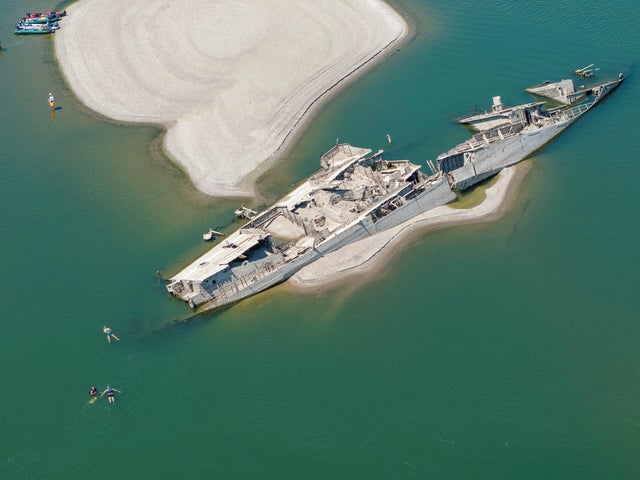
- Water levels on the Danube River, the second longest in Europe, have dropped so low because of drought that the hulks of dozens of World War II German battleships — and even the remains of an ancient woolly mammoth — are emerging into view.
- At least 20 World War II wrecks of various sizes are now visible to the naked eye from the banks of Prahovo.
- Falling water levels in the Danube unveiled bones of a mammoth in Bulgaria, according to a local museum director.
- Historians say up to 200 German warships were scuttled in September 1944 near Prahovo in the Danube gorge as they came under Soviet fire.
- The Danube's record-low water levels have also forced power plants to the brink of shutting down, and governments across Central and Eastern Europe are taking steps to conserve electricity.
- Experts have linked the record low water levels to global warming and other factors.
- Baking temperatures and drought have driven water levels to record lows across large parts of central and eastern Europe, exposing historic and prehistoric relics.
Drought conditions have led to unprecedented low water levels in the Danube River, exposing significant historical artifacts, including at least 20 World War II German shipwrecks and the remains of a woolly mammoth in Bulgaria.1
The Serbian port of Prahovo has become a focal point, where the hulks of German battleships, some still laden with weapons, are now visible. These ships belonged to Nazi Germany's Black Sea fleet, which were deliberately scuttled in September 1944 as they retreated from advancing Soviet forces.
Historians estimate that up to 200 German warships were sunk in the Danube gorge during this period. The sight of these wrecks serves as a reminder of the region's turbulent history, with local authorities long attempting to address the hazardous remnants of war.4
In Bulgaria, the drought has revealed well-preserved mammoth bones, including a jawbone and tusk fragments, near the city of Ruse. Museum director Nikolay Nenov noted that these bones likely belonged to a single animal, making this discovery particularly significant.
The Danube's low water levels have also caused operational challenges, with power plants nearing shutdown and ship traffic nearly halted. Local residents have reported that the river has receded by 15 to 20 meters from its shore, a phenomenon attributed to global warming and other environmental factors.
As the drought continues, authorities are grappling with the dual challenge of preserving historical sites while ensuring safe navigation on the river.
“It's never dried up this much before,” said fisherman Rossen Dobrev, highlighting the unprecedented nature of the current conditions.
“As you can see, the (big) ships can't pass anymore,” added local resident Krsta Brandic, emphasizing the impact on river traffic.
“At least 20 wrecks of Nazi Germany's Black Sea fleet are now visible near Prahovo; historians say up to 200 German warships were scuttled there in September 1944 under Soviet fire. In Bulgaria, specialists identified a jawbone, tusk fragments, shoulder blade and femur from what they say "very likely" was a single woolly mammoth.”


 CBS News
 ABC News & Headlines – Australian Broadcasting Corporation



