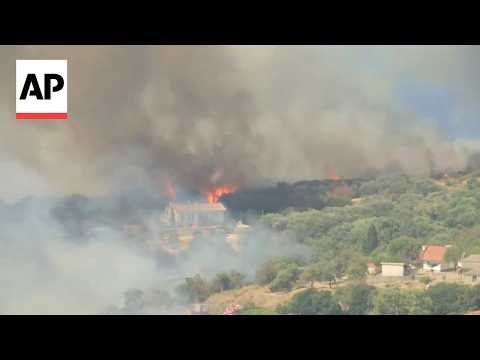
- The fire began on Friday near Agios Vasileios and prompted sea evacuations of 254 people from Agios Vasileios and 12 more from Porto Germeno on Saturday.
- On Sunday, Greek authorities ordered evacuations of three more communities in western Attica and deployed nearly 500 firefighters and 23 aircraft, but gale-force winds strengthened the fire and crippled the response.
- Greek firefighters are battling a huge blaze northwest of Athens, and overnight several settlements on Kefalonia were evacuated after a fire broke out in the Pastra area.
- A wildfire meteorologist put the affected area at 40 to 50 sq km, and a local farmer said a pristine forest was surrendered to the fire: “There are no words to explain what has happened. Destruction. Total destruction.”
- Wildfires have ravaged Europe this summer after a period of record-breaking heatwaves and little rain, conditions scientists say have been exacerbated by climate change, while other countries struggle with drought and receding water levels in major rivers including the Rhine and the Danube.
- Major wildfires in France and Spain appear largely under control; French authorities reported only minor flare-ups in the southwestern Gironde area and no overnight spread in Var, while central Spain was mostly under control despite some re-ignitions.
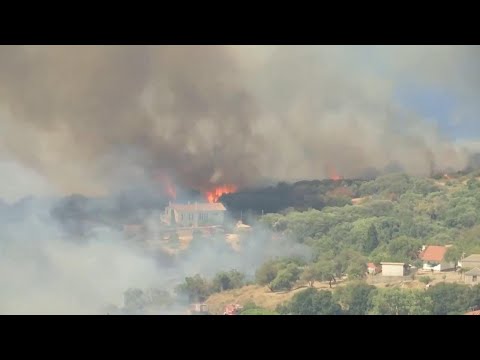
Wildfires in Greece have intensified, forcing the evacuation of hundreds of residents near Athens as gale-force winds fuel the flames. On Sunday, authorities ordered the evacuation of three communities in western Attica, where the fire has threatened villages and industrial areas.34
Nearly 500 firefighters and 23 aircraft have been deployed to combat the blazes, which began on Friday near Agios Vasileios and have since spread into the forested mountains west of Athens. The situation has been complicated by strong winds that have not only intensified the fire but also hampered firefighting efforts.12
Firefighters successfully evacuated 254 people by sea from Agios Vasileios and another 12 from Porto Germeno, utilizing coastal escape routes as roads became impassable due to fire and smoke. A wildfire meteorologist, Theodore Giannaros, estimated that the blaze has affected between 40 to 50 sq km (15 to 19 sq miles), although no official figures have been released yet.78
In contrast, Western Europe is witnessing a retreat from its wildfire crisis, with major fires in France and Spain largely under control. In France, the Gironde megafire has been contained after burning 420 sq km (162 sq miles) of forest, while in Spain, firefighters are managing re-ignitions after significant blazes.910
The ongoing crisis highlights the impact of climate change, which has exacerbated conditions for wildfires across Europe this summer, leading to record-breaking heatwaves and prolonged droughts.
“Nearly 500 firefighters and 23 aircraft are deployed as gale-force winds strengthen the fire, with 254 people evacuated by sea from Agios Vasileios and 12 more from Porto Germeno. Separately, low water in the Danube has forced Hungary to shut its sole nuclear power plant for the first time in over four decades.”


 The Guardian



