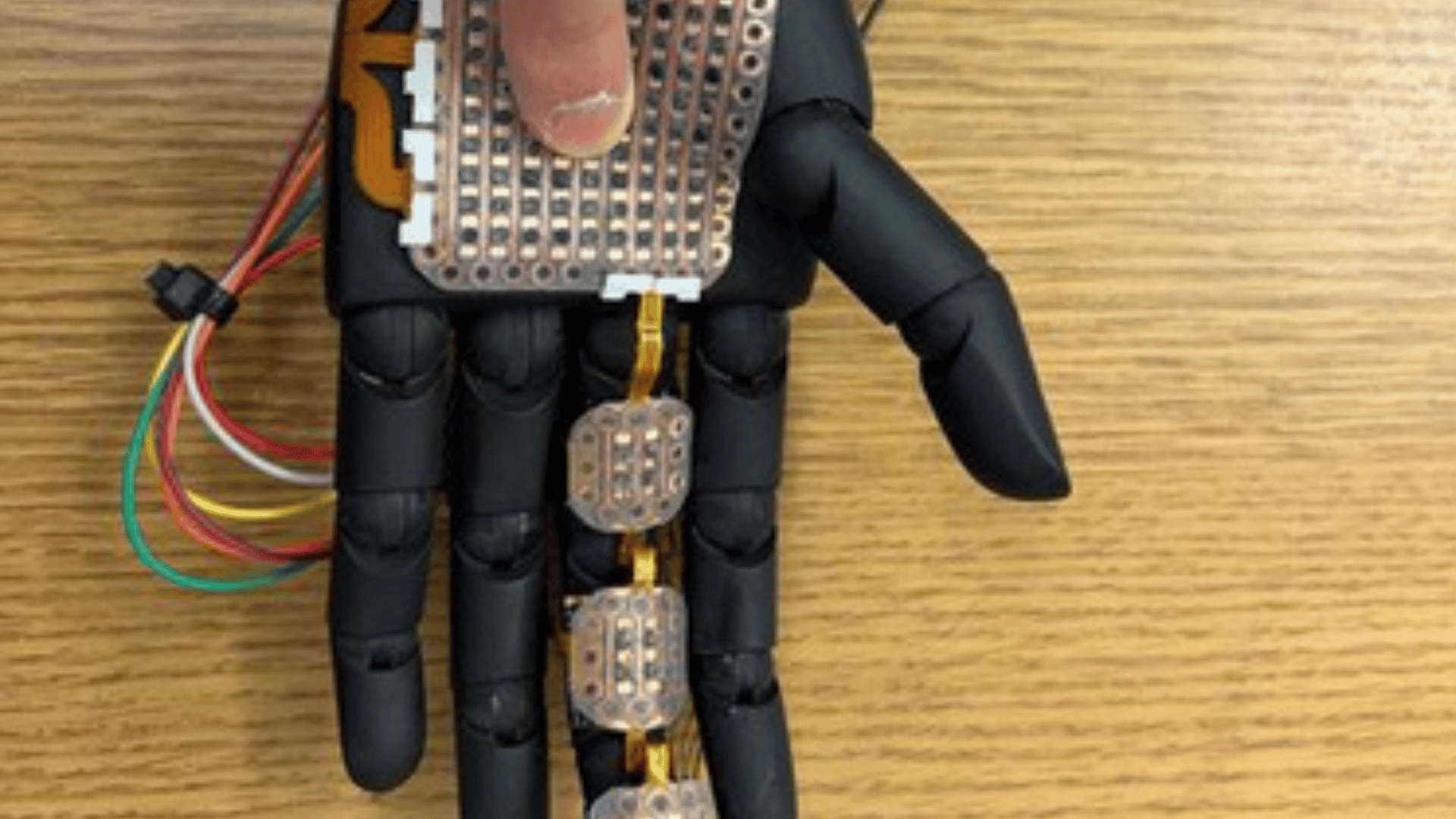
- Researchers at Washington State University have created an electronic skin that can sense pressure and temperature.
- The skin uses a scan-model-print method with 3D printing and laser cutting, allowing sensor modules to snap together like Legos without adhesives.
- This work, published in Cell Reports Physical Science, demonstrates sensing at a scale ten times finer than current commercial glove sensors.
- The team has submitted an invention disclosure for a provisional patent and is working on an actuator for future haptic stimulation.
- The sensor modules are built like thin sandwiches, containing temperature and pressure sensors that enable the skin to reliably identify textures and materials, much like real human skin.
- The technology aims to bring prosthetic devices closer to the behavior of natural skin, allowing them to recognize not only whether they are touching an object but also details about its texture and material.
- Although the system does not yet provide sensation directly to an amputee, it represents an important step toward prosthetics that can gather and eventually transmit tactile information to the nervous system.
Researchers at Washington State University have created an innovative electronic skin that can sense both pressure and temperature, significantly enhancing the functionality of prosthetics. This technology, detailed in the journal Cell Reports Physical Science, operates at a scale ten times finer than current commercial glove sensors.1345
The electronic skin is constructed using a “scan-model-print” method, which involves 3D printing and laser cutting materials. The sensor modules are designed like thin sandwiches, allowing them to reliably identify textures and materials, much like real human skin. “Our main manufacturing method using and laser cutting is relatively simple, so that it could be relatively low cost and convenient,” said Qiu.8
The researchers aim to democratize the production of medical-grade e-skins, making advanced tactile feedback viable for widespread clinical adoption. “This work lays a crucial foundation for a full bionic skin with both sensing and haptic stimulation functions on prosthetics,” stated Hongyi Shen, a graduate student involved in the project.

While the current system does not yet provide sensation directly to amputees, it represents a significant step toward prosthetics that can gather and eventually transmit tactile information to the nervous system. The technology is designed to bring prosthetic devices closer to the behavior of natural skin, allowing them to recognize not only whether they are touching an object but also details about its texture and material.910
The WSU researchers have already submitted an invention disclosure for a provisional patent and are working on an actuator to convert signals from the e-skin into stimulation for nearby nerves, enhancing the user experience.67
“The sensor modules snap together like Legos without adhesives, and the team has submitted an invention disclosure for a provisional patent. They are now working on an actuator to convert signals into nerve stimulation, aiming for full bionic skin.”
 Tomorrow's World Today
 Bioengineer.org
 News-Medical



