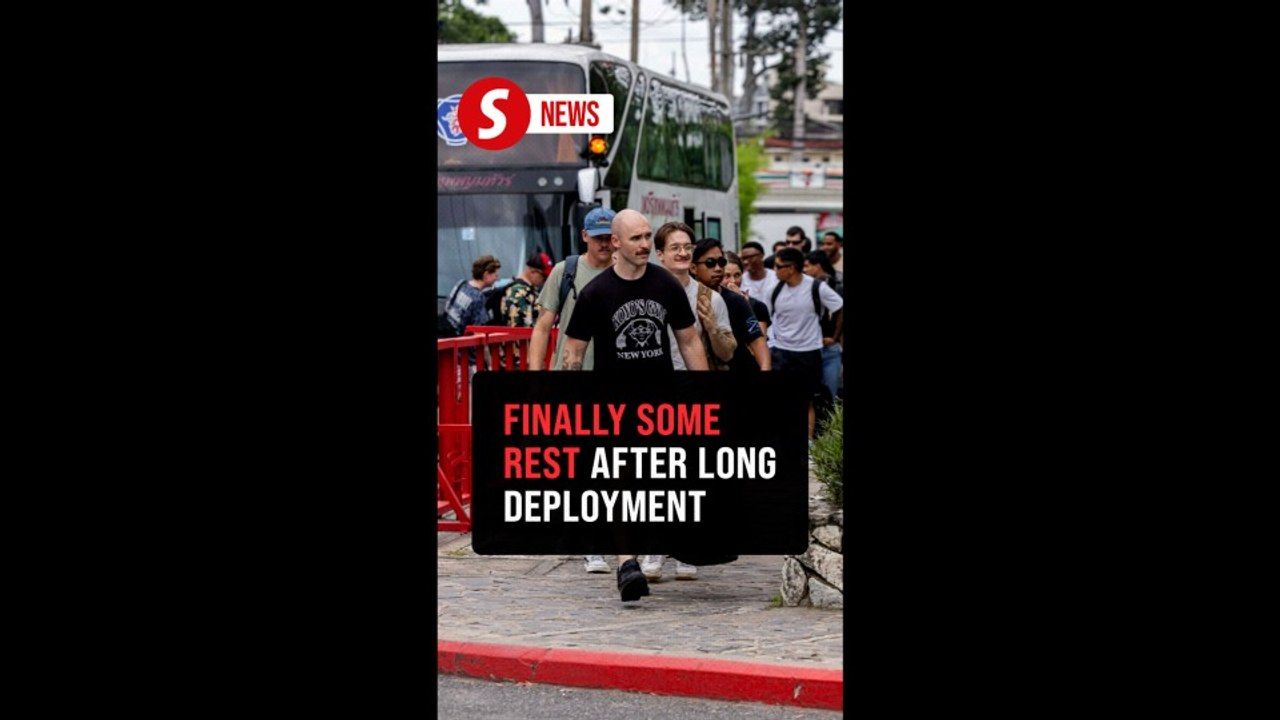
- After 286 days at sea, the carrier USS Abraham Lincoln arrived in Thailand for crew shore leave.
- Observers were shocked by the rusty appearance of the USS Abraham Lincoln in Thailand, with the nearly 1,100-foot-long warship covered in rust from bow to stern.
- Experts say the rust is expected after 286 days at sea since leaving San Diego last November, and rust along the waterline is not unusual after 60 days or more of continuous operations.
- Tackling the rust requires lowering crews to the waterline, sanding off rust, and applying two coats of rust-preventative primer and two coats of naval gray paint, which cannot be done at sea during combat operations.
- Schuster estimated about 30 days of preservation work to remove all the rust, and during a seven-day port visit only high-priority work will be done, starting with the bow and forward hull areas.
- Some rust on upper levels can be treated while underway, but the ship must be stationary and free from wave action for waterline repairs.
- Schuster compared rust to a contagious disease that spreads and weakens steel structures, so it must be removed before it has a decisive impact on components like decks, walkways, and lifelines.
- The long deployment also led to morale problems amid supply shortages, but President Donald Trump dismissed concerns, saying the deployment was “not nearly long enough.”
- Former Navy Secretary John Phelan said Trump would call him in the middle of the night about the rust problem, quoting Trump as saying “Fix the damn rust,” and Phelan noted that fighting rust is one of the two most unpopular naval activities.
The USS Abraham Lincoln, a nearly 1,100-foot aircraft carrier, has drawn attention in Thailand due to its rust-covered appearance after 286 days at sea. Experts, including former US Navy captain Carl Schuster, indicate that such corrosion is expected for vessels on extended deployments.1234
Schuster noted, “Rust along the waterline is not unusual on a ship that has spent 60 days or more of operations continuously at sea.” He explained that addressing the rust issue requires significant effort, stating, “You are looking at about 30 days of preservation work to remove all the rust.” This work cannot be performed while the ship is at sea, especially during combat operations, as crews need to be lowered to the waterline to sand off the rust and apply protective coatings.67
During a seven-day port visit, only high-priority work will be completed, focusing first on the bow and forward hull areas, which endure the most damage from saltwater exposure. Schuster emphasized the importance of early intervention, saying, “Rust is like a contagious disease. It spreads.” He warned that if not addressed, rust can weaken the ship's structure, impacting critical components.910
The Lincoln's long deployment has also raised concerns about morale and supply shortages among the crew. Despite these issues, US President Donald Trump has downplayed the situation, asserting that the deployment was “not nearly long enough.” Former Navy Secretary John Phelan recalled Trump's insistence on addressing the rust problem, stating, “Get those ships out of maintenance yards. Fix the damn rust.”1112131415
“The carrier's long deployment also sparked morale problems amid supply shortages, with President Trump dismissing concerns as 'not nearly long enough.' Former Navy Secretary John Phelan said Trump would call him at night about the rust, urging 'Fix the damn rust.'”