
- The U.S. military carried out new strikes targeting an Iranian drone operation that posed a threat to U.S. forces and commercial shipping in the Strait of Hormuz, a U.S. official said, hours after President Donald Trump dismissed an Iranian report of a deal to restore traffic through the strategic waterway.
- Trump dismissed an Iranian state TV report that it had obtained an unofficial draft of an agreement to restore commercial shipping through the strait to prewar levels, stating, "Nobody's going to control the strait".
- It is the second time in three days that the US has attacked targets in Iran, saying that the strikes were conducted in self defence.
- Centcom described its actions as 'measured, purely defensive, and intended to maintain the ceasefire'.
- Iran condemned the strikes as 'a grave violation of the ceasefire' and vowed that the Iranian government 'will not leave any act of hostility unanswered'.
- The U.S. Treasury Department later sanctioned the Iranian body set up to manage passage through the strait, seen as posing threats to U.S. national security.
- The US imposed sanctions on the 'Persian Gulf Strait Authority' – the Iranian body tasked with collecting payments from ships travelling through the Strait of Hormuz.
- US Treasury Secretary Scott Bessent described it as the 'Iranian military's latest attempt to extort global maritime trade' and 'proof' Iran is 'desperate for cash'.
The U.S. military's latest airstrikes targeted four Iranian drones and a control station in Bandar Abbas, amid ongoing tensions in the Strait of Hormuz. President Trump dismissed claims of a shipping deal with Iran, reiterating that the strait will remain open to all vessels.123
The U.S. strikes were conducted as a defensive measure against threats to American forces and commercial shipping. U.S. Central Command stated that the military '[has] the right to self-defense,' characterizing these actions as measured and defensive.

Following the attacks, Iran's Islamic Revolutionary Guard Corps (IRGC) declared their response a 'serious warning' to the U.S., emphasizing that 'aggression will not go unanswered'. In a retaliatory move, the IRGC reported targeting a U.S. airbase, claiming it was a reply to U.S. strikes around the strait.
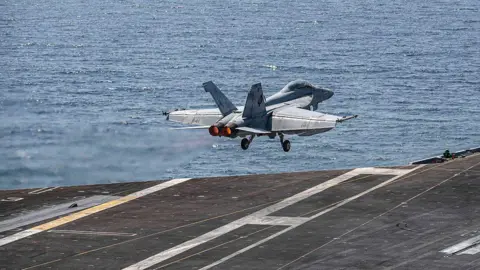
Tensions escalated further as U.S. sanctions targeted the Iranian body managing maritime passage through the strait, alongside threats from Trump of resuming large-scale bombing campaigns if Iran fails to engage cooperatively in negotiations. The strait, a critical chokepoint for global oil and gas, faces disruptions affecting global fuel trade amid rising military actions.
In recent days, twenty-three vessels have reportedly passed through Hormuz under Iranian oversight, in stark contrast to the usual daily figure of 125 to 140 vessels prior to the conflict.
“The US military has conducted new strikes against Iran following Trump's denial of reports concerning a deal on the Strait of Hormuz. This marks the second attack on Iranian targets within three days amid escalating tensions in the region.”


 BBC
BBC