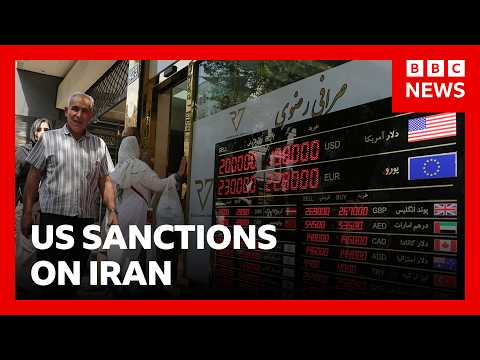
- The United States announced new sanctions on Iran and global entities doing business with the country, calling it an economic D-Day and officially dubbing it Operation Economic Outcast.
- Experts view the sanctions as a pivot from failed military pressure. Negar Mortazavi, senior fellow at the Center for International Policy, said the economic D-Day declaration underscores the war's failure to force Iran's surrender.
- Ryan Costello, policy director at the National Iranian American Council (NIAC), described the war as a catastrophic mistake despite the US military advantage.
- Trita Parsi, head of the Quincy Institute, said Trump's initial threat of war was a fundamental miscalculation because Iran fought back hard.
- Experts doubt the sanctions will force capitulation; Parsi said Iran would rather escalate, and Mortazavi noted that economic hardship does not automatically translate into political capitulation.
- Retired US Army four-star general Barry R McCaffrey warned that the US may have permanently lost access to 15 Persian Gulf bases.
- Jamal Abdi, head of the NIAC, said the administration pivoted to economic tools because it is running out of runway and is scaling back to pre-war policy presented as new pressure.
- Sina Azodi, assistant professor at George Washington University, called the sanctions a psychological operation that will create chaos and uncertainty but likely not change Iranian calculations in the short term.
The United States has launched 'Operation Economic Outcast,' imposing new sanctions on Iran as military strategies falter.1
The sanctions aim to pressure Tehran into negotiations, reflecting a shift from military to economic tactics.
Negar Mortazavi, a senior fellow at the Center for International Policy, stated, “The United States is returning to economic pressure because military force has failed to deliver the quick victory it expected.”2
This move, described as an “economic D-Day,” highlights the ongoing challenges faced by the U.S. in achieving its political objectives in the region.
Ryan Costello, policy director at the National Iranian American Council, remarked, “On paper, the US and Iran are a huge military mismatch,” indicating the destructive capabilities of both sides.
Experts like Trita Parsi criticized the initial military strategy, asserting, “It was a fundamental miscalculation... the threat of war will compel the Iranians to surrender.”4
The sanctions are expected to exacerbate economic hardships for ordinary Iranians, but “years of maximum pressure have shown that economic hardship does not automatically translate into political capitulation,” according to analysts.56
Jamal Abdi, head of the NIAC, noted, “I think it became clear the US is running out of runway on this.”8
As the U.S. pivots back to economic tools, experts warn that while sanctions may create chaos, they are unlikely to shift Iranian policy in the short term.
“Experts like Trita Parsi of the Quincy Institute call the initial war threat a 'fundamental miscalculation' since Iran fought back hard. Retired General Barry McCaffrey warns the US may have permanently lost access to 15 Persian Gulf bases.”