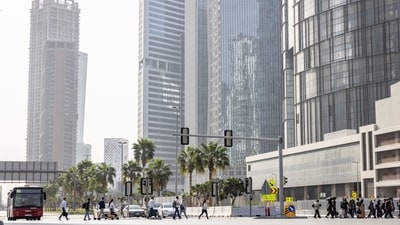
- The UAE announced it was suspending trade with Iran, citing "regional escalations" and coinciding with the US declaring "economic warfare" on Tehran.
- The UAE announcement coincided with a US campaign to inflict economic pain on Iran, and one day later President Trump launched a major new campaign to target Iran's economy.
- The UAE took a hawkish stance on Iran early in the war, recalling its ambassador to Tehran and shutting schools and hospitals linked to the Iranian state, but a detente appeared after a US-Iran memorandum of understanding in June.
- Experts say the UAE is sending a message to Iran over attacks on Emirati tankers in the Strait of Hormuz, while also signalling alignment with the US, though halting trade is unlikely to curb illicit flows of sanctioned oil money.
- If fully enforced, the suspension could be very detrimental to Iran's economy and cause losses on the UAE side as well, according to Karen Young, a senior fellow at the Middle East Institute.
- Billions of dollars of Iran's sanctioned oil revenue moves through the UAE via opaque shell companies based in China/Hong Kong, so halting direct trade may still allow billions in oil revenue to reach Iran indirectly, according to Max Meizlish of the Foundation for Defense of Democracies (FDD).
The UAE's recent suspension of trade with Iran comes amid escalating tensions in the region and a US-led campaign against Tehran's economy. The UAE cited regional escalations as the reason for its decision, which experts believe is a clear message to Iran following its attacks on Emirati tankers in the Strait of Hormuz.
In the past ten months, Iran's trade with the UAE reached $21 billion, with the UAE accounting for 30.6 percent of Iran's imports in 2024. The UAE is also a significant export destination for Iran, receiving 12 percent of its exports, valued at over $7 billion.
Karen Young, a senior fellow at the Middle East Institute, warned that if the UAE's decision is fully enforced, it could be detrimental to both Iran's economy and the UAE's trade interests. Max Meizlish from the Foundation for Defense of Democracies noted that while halting direct trade may seem impactful, billions of dollars in sanctioned oil revenue could still reach Iran through indirect channels, such as opaque shell companies based in China and Hong Kong.910
The UAE's announcement aligns with a broader strategy by the US to inflict economic pain on Iran as the conflict continues without a clear resolution. This move follows a period of apparent detente after a memorandum of understanding was signed between the US and Iran in June, indicating a shift back to a more hawkish stance by the UAE against Tehran.
“Experts say the suspension is a message to Iran over attacks on Emirati tankers in the Strait of Hormuz, but halting direct trade may still allow billions in sanctioned oil revenue to reach Tehran via opaque shell companies in China and Hong Kong, according to FDD's Max Meizlish.”