- US President Donald Trump signed an order on Thursday imposing a 15% tariff and setting minimum import prices on polysilicon, a key material used in solar panels and semiconductors.
- The measures are set to take effect on December 4, 2025.
- The Chinese embassy criticized the move, stating it 'seriously disrupts' trade and that Beijing will act to protect its companies.
- The Commerce Department launched an investigation in July 2025 under Section 232 of the Trade Expansion Act of 1962 regarding polysilicon imports.
- China is a major player in the world's solar supply chain, and the investigation was prompted by concerns over its dominance.
- Trump's order aims to protect US manufacturers facing competition from China's chip industry, which has been a source of friction between the two nations.
US President Donald Trump has signed an executive order imposing a 15% tariff on polysilicon imports, a critical material for solar panels and semiconductors, as part of efforts to strengthen domestic manufacturing and counter China's influence in these industries.15
The order, which will take effect on December 4, also establishes minimum import prices: $21 per kilogram for polysilicon, $100 per kilogram for polysilicon ingots and wafers, $0.22 per watt for solar cells, and $0.38 per watt for solar modules.
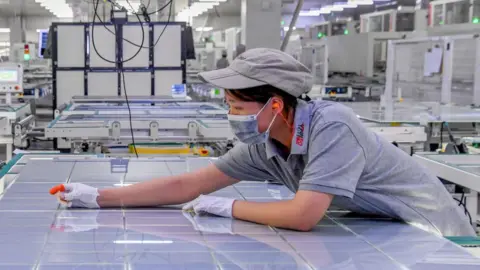
This decision follows a Commerce Department investigation into the impact of foreign imports on US manufacturers, with Secretary of Commerce Howard Lutnick emphasizing the need to bring the supply chain back to the US. “We’re setting prices so that the Chinese can’t dump anymore,” he stated.
The Chinese embassy criticized the tariffs, claiming they “seriously disrupt trade” and asserting that protectionism will not enhance US competitiveness.3
Trump highlighted that US production of polysilicon has plummeted from 50% in 2005 to less than 2% in 2024, with China holding a near monopoly. The order aims to support US firms like Hemlock Semiconductor and Wacker Chemie, which are the main domestic producers.
The move is part of a broader strategy to limit China’s role in critical technology supply chains, following previous restrictions on imports of drones and other tech products.
“Today’s decision encourages continued investment in U.S. capacity and supports long-term U.S. competitiveness,” a spokesperson for Corning stated, while Wacker Chemie is reviewing the implications of the new measures.
“The order sets minimum import prices of $21 per kilogram for polysilicon and $0.38 per watt for solar modules, with measures taking effect December 4. Chinese embassy called the move an abuse of state power, vowing to protect its companies.”
 BBC
BBC



