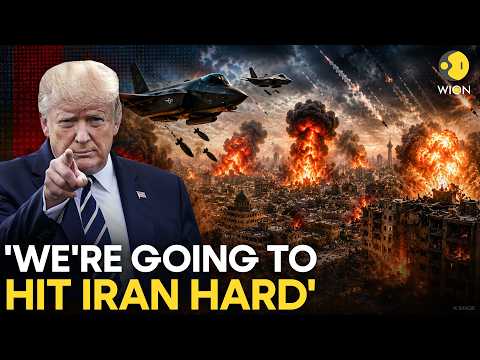
- Late Sunday, the United States attacked two Iranian rocket launchers reportedly seeking to deploy new mines in the Strait of Hormuz; Iran responded by firing missiles toward U.S. forces in Jordan and the United Arab Emirates, though most were intercepted.
- On Monday morning, Trump again attacked Iran, contending it was officially a Failed Nation with leadership in total disarray.
- The modest scale of the exchanges caused West Texas Intermediate crude oil to rise more than 3 percent at one point on Monday, hovering around $86 per barrel, roughly $20 up from prewar levels.
- The American public disapproved of Trump's handling of Iran by almost 2 to 1.
- Brett McGurk, a foreign policy adviser and CNN analyst, said that the status quo now favors Washington, not Tehran.
- Shipping through the Strait of Hormuz has increased, though estimates of the scale vary widely.
- Robert Wilkie, former secretary of Veterans Affairs, speculated that the hope is that if the regime cannot pay its internal security forces, there could be a separation between fellow travelers and true believers and further discontent within the population.
- Iranian Foreign Minister Abbas Araghchi said that putting diplomacy back on track isn't impossible but noted it hinges on U.S. understanding that pressure doesn't work.
- Aaron David Miller, former State Department official, contended that easing of traffic restrictions and the economic blockade have persuaded some in the administration that Trump is winning, but he argued such optimism would be a mistake.
- Miller added that both parties think time is on their side and both seem willing to absorb economic and political pain.
- Trita Parsi of the Quincy Institute saw no breakthrough imminent and asserted the U.S. was in a state of strategic disarray.
- Parsi said that if the U.S. strategy is to periodically bomb Iran, it means you do not have a strategy to resolve this.
- Parsi described the conflict as another round in a historic half-century battle with no transformative endings, no Hollywood endings.
New turbulence has emerged in the Iran conflict as the U.S. launched strikes against Iranian rocket launchers in the Strait of Hormuz, which Iran responded to by firing missiles at U.S. forces in Jordan and the UAE. The exchange of fire raises significant questions about the stability of the ongoing war and its implications for President Trump's administration.128
The U.S. attack occurred late Sunday, targeting two Iranian rocket launchers reportedly preparing to deploy new mines in the vital shipping route. In retaliation, Iran fired several missiles at U.S. forces, although most were intercepted, indicating a potential escalation in hostilities.
The conflict has already impacted global oil prices, with benchmark West Texas Intermediate crude rising over 3 percent to around $86 per barrel, significantly higher than prewar levels. This economic strain is compounded by a growing disapproval among the American public regarding Trump's handling of Iran, with a disapproval rate of nearly 2 to 1.6
Experts suggest that the current status quo may favor Washington, as noted by Brett McGurk, a foreign policy adviser, who stated, “the status quo — perhaps for the first time since the war began — now favors Washington, not Tehran.” However, analysts warn that both sides are prepared for escalation, with Trita Parsi asserting that the U.S. is in a state of “strategic disarray.”714
As the situation evolves, the potential for further conflict remains high, with no clear resolution in sight. “No matter how this ends, it’s just another round in a historic half-century battle between the Islamic Republic and the U.S.,” Parsi concluded.16
“West Texas Intermediate crude oil rose more than 3% to around $86 per barrel, roughly $20 above prewar levels, reflecting market jitters. Meanwhile, the American public disapproves of Trump's handling of Iran by almost 2 to 1, and analysts like Trita Parsi see no breakthrough, calling the US in 'strategic disarray.'”