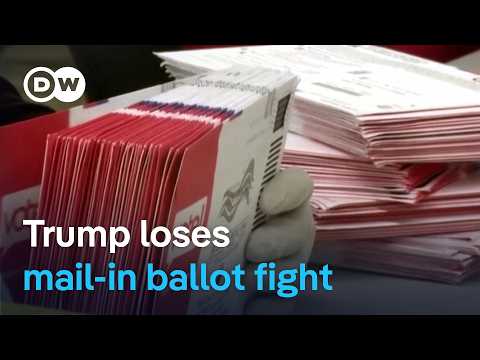
- The U.S. Supreme Court blocked the Trump administration's efforts to disrupt mail voting, allowing mail voting to proceed as usual.
- On Sept. 14, the Supreme Court upheld the preliminary injunction, with Justices Thomas and Alito dissenting, stating the federal government is unlikely to succeed on the merits.
- Trump criticized the Supreme Court over the mail ballot ruling.
- The controversy began in March 2026 when President Donald Trump issued an executive order aimed at ensuring "integrity in federal elections", which mandated the U.S. Postal Service to implement uniform ballot and envelope requirements and required states to provide voter lists.
- The executive order instructed the USPS not to deliver ballots that didn't comply with its requirements or were sent by someone not on a state-provided list, effectively canceling those votes.
- Two lawsuits challenging the executive order were filed, arguing that the president lacks unilateral authority to alter election methods and that the Constitution vests authority in the states.
- The U.S. District Court in Boston issued injunctions against the federal government, forbidding enforcement of the executive order regarding mail and absentee voting.
- The Supreme Court initially ruled in favor of the Trump administration on Aug. 24, finding that states lacked standing because the USPS had not yet implemented the order.
- The USPS subsequently published rules with three key provisions, including envelope design approval, a 30-day electronic portal deadline, and non-acceptance of non-compliant ballots, which caused confusion among election officials.
The U.S. Supreme Court's recent ruling on Sept. 14, 2026, has effectively blocked President Trump's executive order aimed at altering mail-in voting procedures. The court upheld a preliminary injunction that prevents the enforcement of new USPS rules requiring strict compliance for mail ballots.12345
The controversy began in March 2026 when Trump issued an executive order designed to ensure "integrity in federal elections." This order mandated uniform ballot and envelope requirements and required states to provide the USPS with lists of eligible voters 60 days before Election Day.678
Critics argued that the president lacks the unilateral authority to change voting methods, as the Constitution grants states the power to regulate the "time, place, and manner" of federal elections. Two lawsuits were filed against the executive order, leading to a ruling by a U.S. District Court judge in Boston that favored the plaintiffs.
The Supreme Court's decision suggests a supermajority believes the USPS exceeded its constitutional authority. The court stated that the federal government "is unlikely to succeed on the merits of its challenge," indicating that the ruling likely settles the issue of the USPS rules impacting the upcoming midterm elections in November.
As a result, mail voting will continue without the restrictions proposed by the Trump administration, ensuring that ballots will be accepted as long as they comply with existing state laws.
“The Supreme Court's Sept. 14 ruling, with Justices Thomas and Alito dissenting, stated the federal government is unlikely to succeed on the merits, suggesting the USPS exceeded its constitutional authority. This likely settles the impact of the rules on the November midterms.”