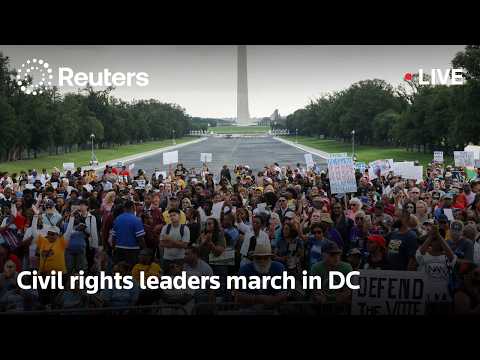
- Thousands of demonstrators have converged on Washington, DC, to warn of threats to voting rights ahead of November’s midterm elections.
- Friday’s event marked the 63rd anniversary of the March on Washington, an historic 1963 protest that galvanized the US civil rights movement.
- The Supreme Court ruling in Louisiana v. Callais struck down key provisions of the Voting Rights Act of 1965, allowing states to redraw congressional maps in ways that erode equal representation in Black communities.
- Civil rights leaders at the march expressed concerns about troubling trends that threaten the voting power of Black and minority citizens.
- Reverend Al Sharpton stated, 'We stand on the same ground because the work is not finished,' emphasizing the ongoing struggle for voting rights.
- A federal judge temporarily halted the implementation of an executive order restricting mail-in voting, as new claims were filed in a lawsuit against it.
- The 1963 March on Washington was a pivotal event in the civil rights movement, advocating for jobs and freedom.
- The Voting Rights Act of 1965 was designed to combat practices that disenfranchised Black voters and had previously prevented lawmakers from redrawing congressional districts based on race.
- The April ruling by the Supreme Court's conservative majority argued it was impossible to 'disentangle race from politics,' effectively legalizing discrimination in redistricting.
Thousands of demonstrators gathered in Washington, D.C., for the 'Defend the Vote' march, commemorating the 63rd anniversary of the historic March on Washington. The event highlighted ongoing threats to voting rights, particularly following a Supreme Court ruling that weakened the Voting Rights Act of 1965.1238
Civil rights leaders, including Rev. Al Sharpton and Sen. Bernie Sanders, voiced concerns over recent legislative changes that they argue disenfranchise Black and minority voters. “We know in this fight we’re fighting powerful forces, but this is why we rally today,” said Marc Morial, president of the National Urban League.5
The Supreme Court's April decision in Louisiana v. Callais allowed states to redraw congressional maps, often diluting Black representation. “Today, we have a president along with the Supreme Court members he appointed carrying out the most significant assault on voting rights since segregation,” Sanders stated.
Sharpton emphasized the importance of continued activism, stating, “the work is not finished.” He criticized the current administration for actions perceived as limiting voting access, including advocating for stricter proof of citizenship.
The march served as a rallying point for advocates of voting rights, with participants expressing determination to combat legislative efforts that threaten electoral participation. “This march is about people who refuse to be counted out,” said Rep. Cleo Fields, whose district was affected by the Supreme Court ruling.
As the midterm elections approach, the urgency of protecting voting rights remains a central theme for civil rights advocates.
“The march follows the Supreme Court's April decision in Louisiana v. Callais, which critics say allows states to redraw maps that dilute Black voting power. Organizers filed new claims against an executive order restricting mail-in voting, and a federal judge temporarily halted its implementation.”



 The Globe and Mail