
- LHS 1140b has been identified as the first rocky planet with a confirmed atmosphere located in the habitable zone outside our solar system.
- In 2024, helium escaping from LHS 1140b was detected, indicating the presence of an atmosphere.
- However, in 2025, helium was not detected in subsequent observations, leading to a reanalysis of the initial findings.
- After ruling out false positives, scientists confirmed the atmosphere of LHS 1140b in 2025.
- Planetary scientist Collin Cherubim stated that LHS 1140b has the necessary conditions for a habitable environment, including a rocky surface, a temperature that supports liquid water, and an atmosphere to retain that water.
- LHS 1140b orbits a star located 48 light years from Earth and is about 1.7 times the diameter of Earth, with a mass 5.6 times greater.
Planetary scientist Collin Cherubim of the University of Chicago has confirmed the first atmosphere on a rocky exoplanet, LHS 1140b, located 49 light years from Earth. This groundbreaking discovery indicates that LHS 1140b has the necessary conditions for liquid water, a key ingredient for life.15
LHS 1140b is about 1.7 times the diameter of Earth and has a mass 5.6 times greater. It orbits its star every 24.7 days, significantly closer than Earth’s distance from the Sun. Cherubim stated, “A living world has got to be the right temperature to sustain liquid water on the surface, and it has to have an atmosphere to hold that water in place and to shield the surface from ionizing radiation.”6
The atmosphere was confirmed through the detection of helium escaping into space, a significant finding as it marks the first direct identification of an atmospheric species for any rocky exoplanet. Cherubim noted, “My models do predict carbon dioxide to be the second most abundant gas, and carbon monoxide to be present, and also small amounts of O2 molecular oxygen.”2
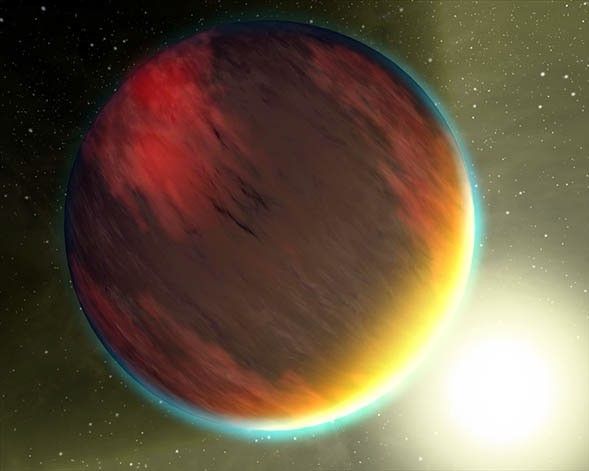
The star LHS 1140b orbits is relatively quiet, providing a stable environment for potential life. Cherubim emphasized the importance of this discovery, stating, “That makes this discovery of an atmosphere surrounding LHS 1140b a crucial step towards understanding what it’s like living with a red dwarf.” This finding opens new avenues for studying astrobiology and the potential for life beyond our solar system.
“LHS 1140b, with a diameter 1.7 times Earth's and mass 5.6 times, orbits its quiet red dwarf star every 24.7 days at 9 million miles. The atmosphere, first detected via escaping helium in 2024, is modeled to contain carbon dioxide and water vapor, marking the first direct identification of an atmospheric species for any rocky exoplanet.”
 The Guardian
 Ars Technica



