Republicans celebrate twin redistricting victories after Supreme Court ruling 'green-lighting' the process; Louisiana must redraw map by May 16.

The Supreme Court ruling has significant implications, allowing states to redraw electoral maps and potentially undermining the Voting Rights Act. As Republicans gain ground with new seat creations, experts believe the longer-term impacts will be most felt in the 2028 elections.

Sources:
NBC NewsUSA Today
Trending 1h ago
Tab background
Sources: NBC NewsUSA Today
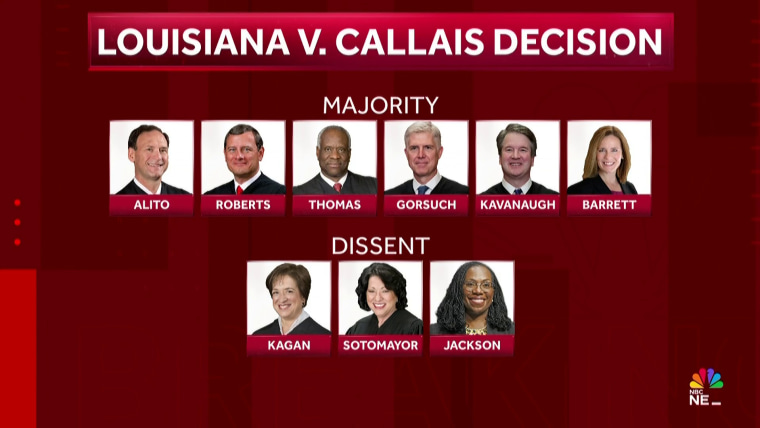
Republicans are celebrating twin victories in redistricting following a recent Supreme Court ruling. The 6-3 decision declared Louisiana's previous congressional map an unconstitutional racial gerrymander, mandating a redraw before the state’s primary on May 16. Conservative Justice Samuel Alito stressed that the map discriminated against non-Black voters.

In Louisiana, the ruling requires a new map reflecting permissible partisan lines rather than relying heavily on racial considerations, which critics argue dilutes minority voting power under the pretext of partisanship.

In Florida, a GOP-led legislature has passed a new congressional map creating four additional Republican-leaning seats, further bolstering the party's chances in upcoming elections. The state, following others since 2025, may allow Republicans to gain as many as 13 seats, while Democrats could secure around 10. This shift has raised concerns from civil rights advocates, who describe the ruling as a “devastating blow” to the Voting Rights Act, allowing for systematic dilution of minority voter power.

Experts like Wilfred Codrington note that this decision effectively “guts a key pillar of the Voting Rights Act,” enabling states to manipulate district lines without overt racial bias allegations. The broader implications of this ruling will likely influence future elections beyond 2026.
Sources: NBC News
Republicans are celebrating a significant Supreme Court ruling allowing Louisiana to redraw its congressional map before the May 16 primary, declaring the previous map an unconstitutional racial gerrymander. Florida has also enacted a new map that could potentially add Republican-leaning seats ahead of the elections.
Section 1 background
The Headline

Republicans celebrate key redistricting victories

Key Facts
  • The Supreme Court issued a ruling that weakened the Voting Rights Act.NBC News
  • The ruling means Louisiana will need to redraw its map, with its primary on May 16.NBC News
  • The GOP-led Florida Legislature passed a new congressional map that creates four additional Republican-leaning seats.NBC News
  • Experts note that while the immediate impact on the 2026 midterm elections may be limited, the decision's ripple effects will be felt more in the 2028 election and beyond.USA Today

Related Videos

Why SCOTUS ruling on the Section 2 of Voting Rights Act is a game changer
SCOTUSVoting Rights Actgerrymanderingpolitical advantagemidterm elections
Justices clash in Supreme Court decision limiting Voting Rights Act
Supreme CourtVoting Rights Actgerrymanderingpolitical decisionsJustice Samuel Alito
Supreme Court limits Voting Rights Act
Supreme CourtVoting Rights Actlegal decisioncivil rightsU.S. politics
Supreme Court limits Voting Rights Act
Supreme CourtVoting Rights Actlegal decisioncivil rightscourt ruling
Section 2 background
Background Context

Context on voting rights and redistricting

Key Facts
  • Wilfred Codrington, a professor at Cardozo Law School, remarked that the ruling signifies “them green-lighting anything that the states are going to do.”USA Today
  • Justice Elena Kagan opposed the decision, stating it would systematically dilute the power of minority voters.USA Today
  • Critics argue that the ruling could guts a key pillar of the Voting Rights Act by freeing state legislatures to gerrymander legislative districts under the guise of partisanship.USA Today
  • Based on new district lines, Republicans could pick up as many as 13 seats, while Democrats could gain up to 10.NBC News
Article not found
CuriousCats.ai

Article

Source Citations