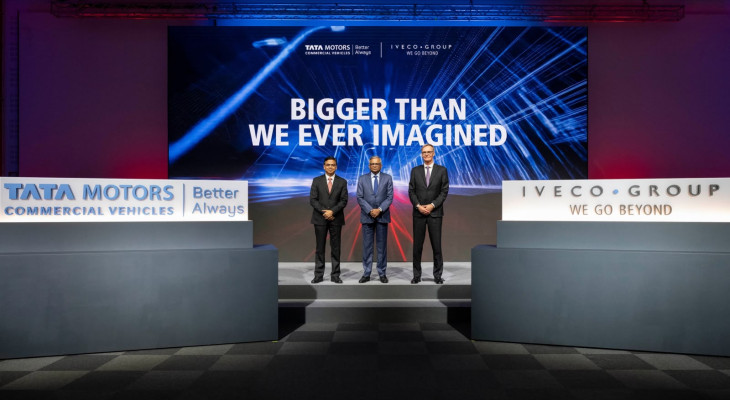
- Tata Motors and Iveco Group have officially combined to create the world’s fourth-largest commercial vehicle manufacturer with combined first-year revenues of approximately €21 billion ($24 billion).
- The deal was finalized following a tender offer concluded in late October 2026, pairing India’s dominant commercial vehicle maker with the Italian truck, bus, and powertrain manufacturer.
- On November 3, 2026, Tata Motors and Iveco Group formally began operations as a combined global commercial mobility enterprise, creating the world’s fourth-largest commercial vehicle (CV) manufacturer by sales volumes in the over-six-tonne segment.
- The combined entity operates in more than 130 countries, with annual sales of approximately 5.9 lakh units and combined revenues of around €21 billion (Rs 2.28 lakh crore).
- The combined business will produce nearly 590,000 vehicles annually across heavy trucks, light commercial vehicles, buses, and specialized industrial equipment in its first year.
- The new entity will have more than 73,000 employees across six continents, supported by 27 manufacturing facilities, 25 research and development centres, and a network of approximately 9,300 sales and service centres.

Tata Motors Limited and Iveco Group N.V. have officially merged to create the world's fourth-largest commercial vehicle manufacturer, with first-year revenues of approximately €21 billion ($24 billion) and annual sales of around 590,000 vehicles.1
The new entity combines Tata Motors' extensive commercial vehicle portfolio, which includes vehicles ranging from sub-one-tonne to 55-tonne cargo vehicles, with Iveco's capabilities in light, medium, and heavy commercial vehicles, as well as buses.
The merger, announced on November 3, 2026, establishes a global presence in over 130 countries and employs more than 73,000 people across six continents. The combined business operates 27 manufacturing facilities and 25 research and development centres, supported by approximately 9,300 sales and service centres worldwide.346
N Chandrasekaran, Chairman of Tata Sons, emphasized the merger's significance, stating, “Two strong and successful organisations, united by shared values, a common commitment to sustainable mobility and an ambition to shape the future of commercial transportation, have come together.”
The merger also enhances technological capabilities, covering conventional combustion engines, natural gas, battery-electric vehicles, hydrogen, and other low- and zero-emission technologies. The companies aim to maintain existing customer contracts and relationships, ensuring continuity during the transition.

Chandrasekaran noted, “In terms of revenues, we are in excess of €21-22 billion with strong financial strength. This should not be seen as a consolidation effort. This is about the future.”
The combination positions Tata Motors to leverage its market leadership in India and emerging markets while benefiting from Iveco's established presence in Europe and Latin America.
“The combined entity will have 27 manufacturing plants and 25 R&D centers, operating in over 130 countries with more than 73,000 employees. The union merges Tata's sub-one-tonne to 55-tonne portfolio with Iveco's FPT powertrain capabilities for combustion, natural gas, battery-electric, and hydrogen vehicles.”
The Indian Express