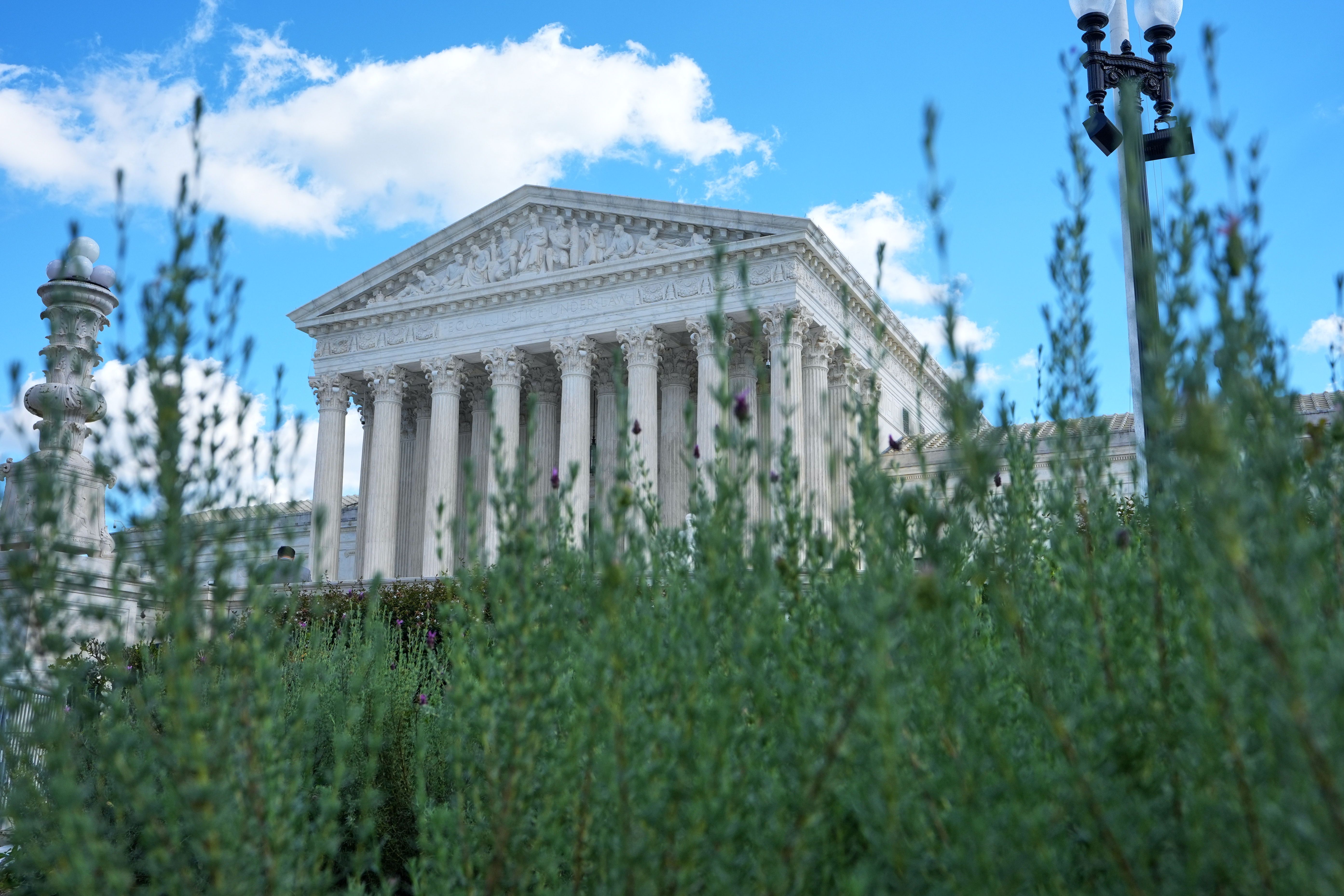
- The Supreme Court cleared the way for New Hampshire to fully ban the use of student IDs for voting during the midterm elections.
- The justices granted a Republican-backed emergency appeal and blocked the use of student IDs as a backup method of identification.
- The Supreme Court cited a longstanding legal principle that judges shouldn’t change voting rules too close to Election Day.
- Justice Ketanji Brown Jackson was the only justice to publicly dissent.
- New Hampshire passed a law this year that said student IDs would no longer be an expressly accepted form of identification for obtaining a ballot.
- The secretary of state then issued guidance barring them as a backup way to prove a voter’s identity.
- A judge left the law in place but blocked the guidance in early October, prompting the appeal to the Supreme Court.
- The 1st U.S. Circuit Court of Appeals declined to put the judge's ruling on hold, prompting the state to ask the Supreme Court to intervene.
- The Supreme Court agreed with the state, finding that the District Court didn’t cite any justification for departing from the principle that federal courts should generally refrain from altering election rules shortly before an election.
- The dispute arises from a state law enacted in April that removed student IDs from the list of forms of identification that election officials would accept when someone requests a ballot.
- The measure was challenged by a nonprofit voting rights group called Coalition for Open Democracy, which argued that it unlawfully burdened the right to vote and discriminated against young voters.
- U.S. District Judge Joseph Laplante declined to block the law, but on Oct. 2 he weighed in again, putting guidance from New Hampshire Secretary of State David Scanlan on hold.
- Scanlan’s guidance said student IDs could not be used for any purpose when people seek ballots, which Laplante said went further than the law itself, which only barred them as a primary source of ID.
- Under Laplante’s ruling, election officials could still take a student ID into account in trying to determine whether someone is a valid voter.
- The Republican National Committee weighed in to support the state.
- The plaintiff’s legal team released a statement saying the Supreme Court’s order is “wrong” and injects confusion into the Nov. 3 election.
- New Hampshire Attorney General John M. Formella stated his team will continue to defend “the safeguards” that state lawmakers have adopted.
- Republican leaders, who hold a majority in each chamber of the New Hampshire Legislature, have said this law and others aim to promote election security.

The Supreme Court's decision on Thursday permits New Hampshire to enforce a complete ban on student IDs as valid voter identification for the upcoming midterm elections, a move supported by the Republican National Committee.115
The ruling stems from a state law enacted in April that removed student IDs from the list of acceptable forms of identification when requesting ballots.10
Justice Ketanji Brown Jackson dissented, stating, “I would not disturb a clearly justifiable federal court order issued to ensure that the public receives accurate information about a State’s electoral processes,” highlighting concerns over potential voter confusion.4
The Supreme Court emphasized the principle that judges should not alter voting rules close to Election Day, agreeing with the state’s argument that a lower court's injunction was issued too close to the November 3 election.
The law has faced challenges from the nonprofit Coalition for Open Democracy, which argues it unlawfully burdens voting rights and discriminates against young voters.11
New Hampshire Attorney General John M. Formella defended the law, asserting, “New Hampshire has a responsibility to protect the integrity of its elections and ensure that election laws are applied as written.”
The decision arrives just weeks before a closely contested U.S. Senate race, raising concerns about the impact on young voters who may rely on student IDs.
The litigation continues as the plaintiff's legal team vows to challenge the law further, asserting that the Supreme Court's order injects confusion into the electoral process.
“The ruling, issued less than two weeks before the Nov. 3 election, blocks a federal judge's injunction that had allowed student IDs as backup identification. Justice Ketanji Brown Jackson dissented, arguing the injunction was "reasonably designed to address alleged misinformation," while the plaintiff, Free Speech For People, vowed to continue pressing the case.”
The Boston Globe