Sources: 
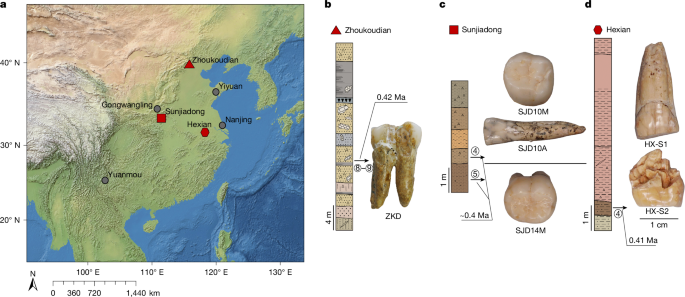
Researchers in China have unveiled compelling evidence that
Homo erectus interbred with
Denisovans around 400,000 years ago, based on protein analysis from six ancient teeth unearthed across various sites in China.
This marks the oldest known instance of hybridization between human groups.
The study, led by
Qiaomei Fu, details two significant mutations in the enamel proteins of these specimens, indicating a direct genetic link to
Denisovans, a human lineage adapted to the Eurasian environment.
According to the findings, these interspecies encounters suggest that both groups not only coexisted but produced fertile offspring, contributing to the evolutionary fabric of modern humans.
“The work reveals two enamel proteins: one unique to Homo erectus, and another shared with the Denisovans—especially the more recent populations—which is evidence of hybridization,” said Antonio Rosas, who emphasized the study's validation of prior hypotheses about human lineage interactions.
The significance of this discovery lies in its confirmation that ancient humans were more interconnected than previously thought, shedding light on the genetic variations present today.
Moreover, this research propels ongoing efforts to unearth more fossil evidence and collect additional DNA samples from early human ancestors to further elucidate their evolutionary relationships.
“We really need to get more DNA and bits of H. erectus to figure out how this predecessor is exactly related to other humans,” added Fu, highlighting the need for continued exploration in the field.
Sources: 
A study reveals that ancient Homo erectus and Denisovans interbred in China around 400,000 years ago, providing the first molecular evidence of such interactions through analysis of enamel proteins from six Homo erectus fossils, highlighting profound implications for understanding human evolution.