- Protests began on July 25 in Ranchi over alleged exam paper leaks and irregularities in JPSC recruitment exams.
- JPSC chairman L Khiangte stepped down on July 22 and was later arrested on Monday.
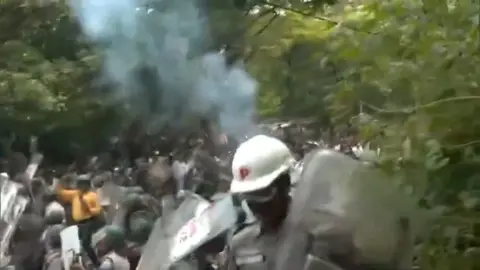
- On Monday, thousands of protesters marched on the state legislature, climbing barricades; police used tear gas, water cannon, and batons to disperse them.
- Student leader Devendra Nath Mahto, on hunger strike for nine days, joined the march on a stretcher, vowing the barbed wires would not stop them.
- The protests are a response to allegations of corruption in the examination system, with demands for an overhaul and an investigation by the federal police.
- Police and paramilitary forces used tear gas, pellet guns and batons in Delhi to disperse protesters, reflecting a broader unrest linked to exam paper leaks.
- The immediate cause of the anger is a preliminary civil service exam held by the Jharkhand Public Service Commission (JPSC) in April, which candidates allege was manipulated.
Thousands of students and job seekers in Jharkhand protested on Monday, demanding reforms to the state's civil service examination system amid allegations of corruption and exam paper leaks.5
The protests began on July 25 and intensified as demonstrators marched towards the state assembly in Ranchi, breaching police barricades.1

Police responded with tear gas, batons, and water cannons, claiming to use minimal force as some protesters became violent. Ranchi City Superintendent of Police Paras Rana stated, "We showed minimal aggression for a really short time because they are just students."3
The protesters are calling for an overhaul of the examination system, cancellation of certain tests, and an investigation by the Central Bureau of Investigation (CBI) into the alleged irregularities. At least six protesters are on an indefinite hunger strike, including student leader Devendra Nath Mahto, who joined the march on a stretcher after fasting for nine days.
The Jharkhand government has agreed to cancel the 14th Jharkhand Public Service Commission (JPSC) preliminary exam and two backlog recruitment tests, leading to the resignation of three JPSC board members. However, protesters insist their demands remain unmet, particularly regarding the CBI investigation.
The protests reflect broader frustrations over corruption in education and high unemployment rates in one of India's poorer states. The agitation has garnered political support, with the opposition Bharatiya Janata Party (BJP) backing the protesters and demanding a federal investigation.
As tensions rise, the state government warns against politicizing the protests, emphasizing the need for justice and resolution.
“At least six protesters remain on an indefinite hunger strike, including student leader Devendra Nath Mahto, who joined the march on a stretcher after fasting for nine days. The state government has agreed to cancel the JPSC preliminary exam and two backlog tests, but protesters demand a CBI investigation into paper leaks.”


 BBC
BBC



