- STAR collaboration has published findings in Science on Aug. 13, suggesting that the baryon number of protons is carried by a Y-shaped gluon junction rather than solely by valence quarks.
- The long-standing assumption was that each of a proton's three valence quarks carries 1/3 of the baryon number.
- An alternative idea proposed is that the baryon number resides in a Y-shaped gluon junction connecting the three quarks.
- The STAR collaboration analyzed photonuclear and isobar collisions at the Relativistic Heavy Ion Collider (RHIC), comparing results with computational models.
- Results indicate that baryons travel farther through the collision zone than electric charge, supporting the junction model.
- The baryon number is a defining characteristic of protons and related particles, traditionally thought to be carried by quarks.
- The junction model suggests that baryon number is more favorably carried by gluons when arranged in a special configuration.
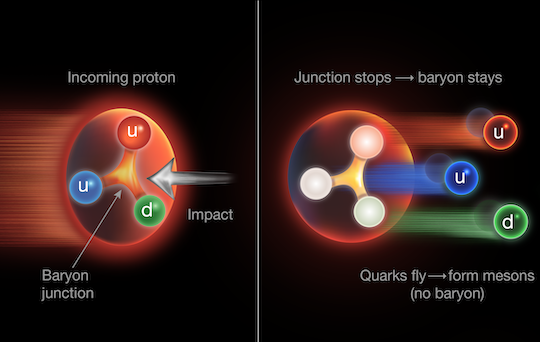
- The research indicates that the baryon junction can be stopped more easily than the three quarks, leading to new baryons being emitted in perpendicular directions.
A new study from the STAR collaboration published in *Science* challenges the long-held belief that baryon number is carried by valence quarks in protons. Instead, it suggests that a Y-shaped junction of gluons, which bind quarks together, is responsible for this fundamental property.16
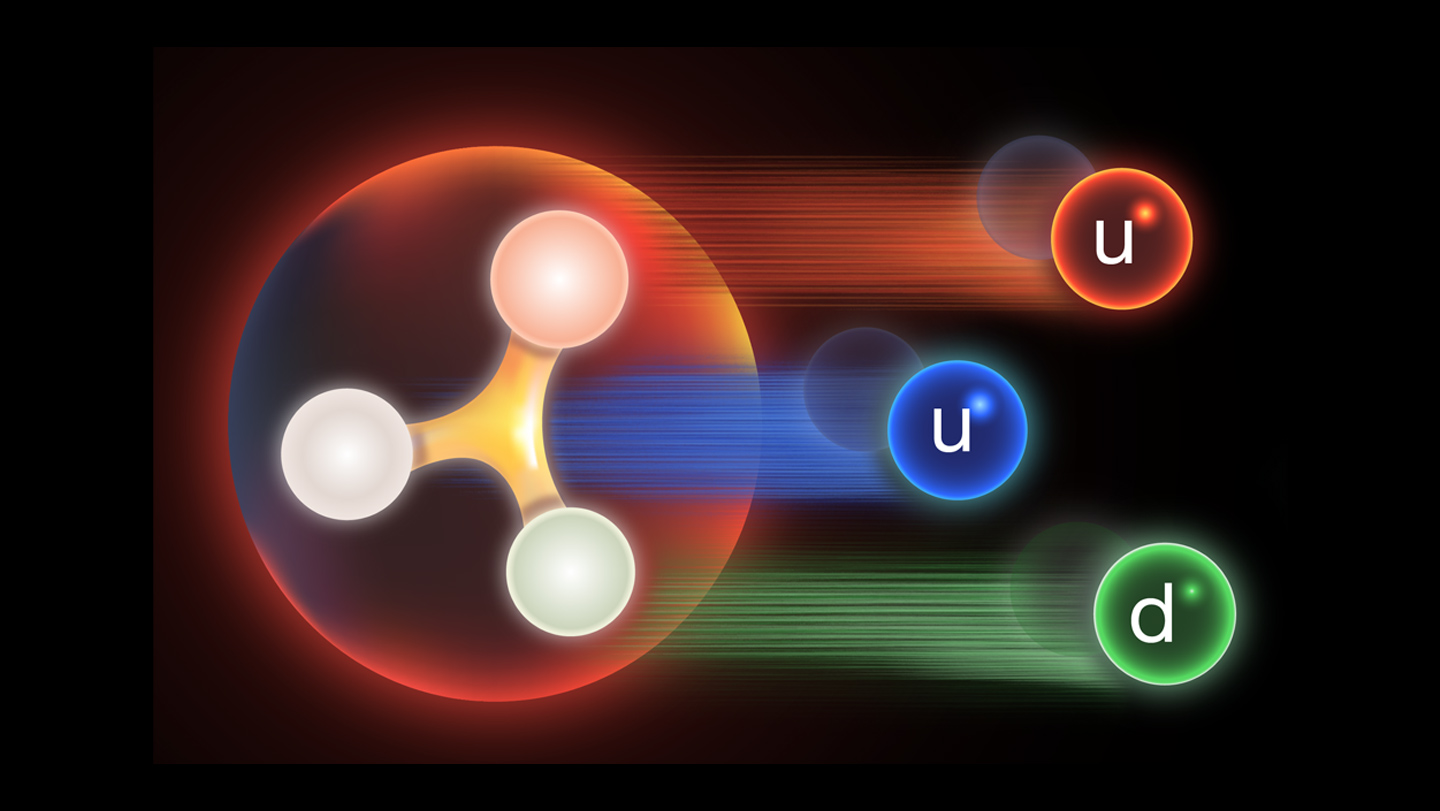
The research analyzed photonuclear and isobar nuclear collisions, revealing that baryons travel further through collision zones than electrically charged quarks. “The baryon number is carried by the junction, which isn't slowed as much as the electrically charged valence quarks,” the researchers stated. This finding discredits the traditional view that each of a proton's three quarks contributes one-third to the baryon number.45
The study's lead physicist, Nicole Lewis, noted, “Unexpectedly, the data we generated with the new method didn’t align with the predictions based on the conventional baryon number carrier model.” The results indicate that the baryon junction model is more consistent with observed phenomena, as it explains how baryons are emitted in collisions.7
The implications of this research extend beyond particle physics, as understanding baryon number conservation could shed light on the universe's matter-antimatter imbalance. “Determining whether quarks or the gluon field transports baryon number could contribute to understanding how strong interaction between subatomic particles organizes stable matter,” said researcher Li. The STAR collaboration's findings pave the way for future investigations, particularly with the upcoming Electron-Ion Collider, which may provide further insights into this complex area of study.
“The evidence comes from RHIC collisions where baryons emerge perpendicular to the beamline, as predicted by the junction model. Physicist Chun Shen notes it's 'not the smoking gun yet,' and future Electron-Ion Collider data may further test the theory.”
 ScienceAlert