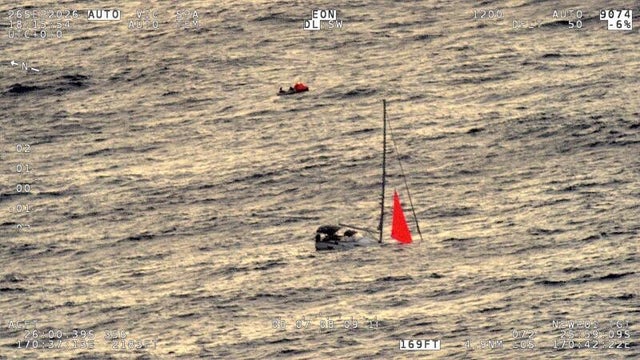
- Sperm whale pod struck the yacht Tai Tam, cracking the hull and smashing the steering gear, leading to a fight for survival for the four sailors on board.
- The crew activated an emergency beacon and declared a full mayday at 1 p.m. New Zealand time on Saturday, about 30 minutes after the whale collision.
- The crew abandoned the yacht late Saturday night, transferring to a life raft as the situation worsened.
- In the early hours of Sunday morning, they cut the tether to the yacht, which soon sank beneath the waves.
- The MV Sofrana Surville rescued the four sailors at 6 a.m. Sunday, approximately 18 hours after the encounter with the sperm whale.
- The incident occurred 250 nautical miles north of Norfolk Island, highlighting the dangers of sailing in areas inhabited by large marine mammals.
- Sperm whales are considered a vulnerable species by the International Union for Conservation of Nature, facing threats from noise pollution and ship strikes.
- This incident marks at least the second time in less than two months that a whale has sunk a boat.
A sperm whale collision sank the yacht Tai Tam, forcing four sailors into a harrowing 18-hour survival ordeal in the South Pacific. The incident occurred 250 nautical miles north of Norfolk Island, where the crew encountered a pod of sperm whales.12791011
"There was sort of a loud thud. The whole boat was pushed sideways," said Australian Jemma Cooper, who was thrown from the steering wheel by the impact. Her husband, Jeremy, was awakened below deck, realizing the situation was dire: “All the steering gear was smashed on the starboard side, and there was a significant amount of water coming in,” he recounted.
At 1 p.m. New Zealand time on Saturday, the crew activated an emergency beacon and declared a full mayday. “We looked out to our port side, and there were six to eight, a pod, of whales there,” Jemma added, confirming the source of the collision.34

As water flooded the yacht, French crew member Martin Jaffre attempted to slow the influx using expansion foam and inspected the hull. Ultimately, the crew abandoned ship, transferring to a life raft under a full moon.56
The Royal New Zealand Air Force coordinated the rescue, and the MV Sofrana Surville located the sailors at 6 a.m. on Sunday. “This was a well-coordinated and executed rescue,” said a military spokesperson, highlighting the crew's preparedness and timely activation of their Emergency Position-Indicating Radio Beacon (EPIRB).8
Sperm whales, known to be able to sink ships, are classified as a vulnerable species by the International Union for Conservation of Nature.
“The crew activated their EPIRB about 30 minutes after the collision, which rescue coordinator Mike Clulow credited as key to their safety. The incident marks the second whale-sinking of a boat in less than two months, following a July attack on a New Jersey fire department boat.”
 CBS News




