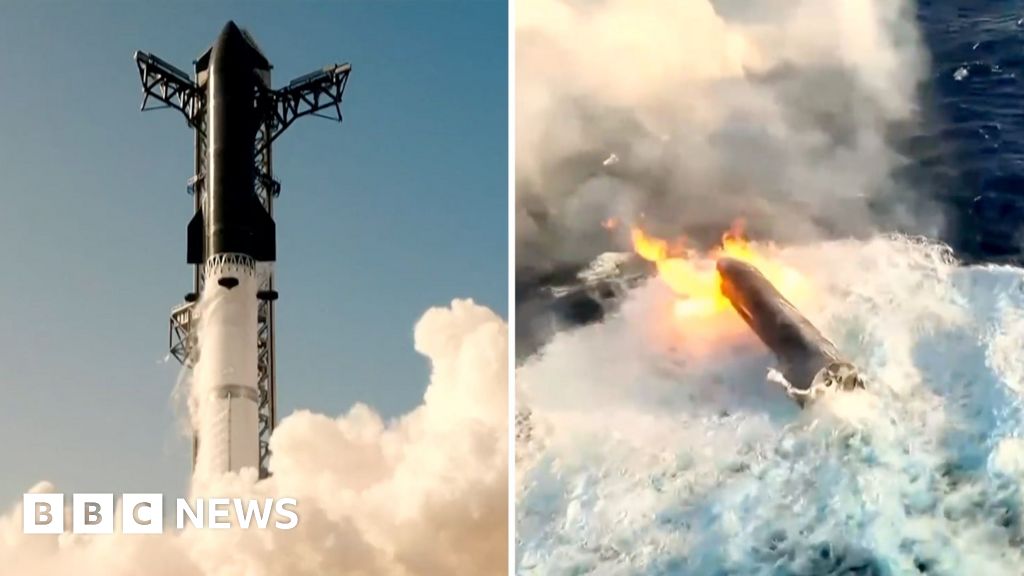
- SpaceX launched its Starship Flight 13 on Friday, marking the first test since the company's IPO last month.
- During the flight, SpaceX successfully deployed 20 of its new V3 Starlink satellites into orbit, a significant milestone for the company.
- However, the Super Heavy booster experienced a failure during a planned simulated landing, resulting in an explosion upon impact with the water.
- This flight was the second for the V3 version of Starship, which is designed to be larger and more powerful than earlier models.
- SpaceX faced engine failures during a previous launch attempt, leading to the replacement of six engines ahead of this flight.
- Despite the booster failure, the upper stage of Starship successfully performed a simulated landing in the Indian Ocean, providing critical data on its heat shield.
SpaceX launched its Starship Flight 13 on Friday, marking the first test since its IPO. The flight successfully deployed 20 V3 Starlink satellites but encountered a Super Heavy booster failure during a simulated landing. The booster exploded upon impact in the Gulf of Mexico, while the upper stage achieved a soft splashdown in the Indian Ocean, providing critical data on its heat shield.1
This test flight, the 13th for Starship, followed a previous aborted attempt due to engine issues. SpaceX replaced six engines before this launch, which took place from its facility in Starbase, Texas. The upper stage performed well, losing no engines during flight, unlike the previous V3 launch in May.

The new Starlink satellites, designed to be larger and more powerful, are expected to significantly enhance the company's downlink capacity. SpaceX claims that launching 60 of these satellites could lead to a 'potential twenty-fold increase' in capacity compared to the Falcon 9.

Despite the successful deployment, the booster failure impacted SpaceX's stock, which has seen a decline from over $200 per share to $115 following the launch. In after-hours trading, shares fell another 2% after the booster incident. Industry experts note that while progress has been made, SpaceX is still 'a long way from achieving rapid reusability' of the entire Starship system.
The flight's success in deploying the Starlink satellites is a crucial step for SpaceX, as this program is currently the only profitable aspect of the company's operations.
“The Starship upper stage survived reentry and performed an intact soft splashdown in the Indian Ocean, for the first time allowing drone inspection of its heat shield. The new Starlink satellites burned up in the atmosphere 20 minutes after deployment, and SpaceX stock fell 2% in after-hours trading following the booster failure.”


 BBC
BBC TechCrunch
 CNBC
CNBC



