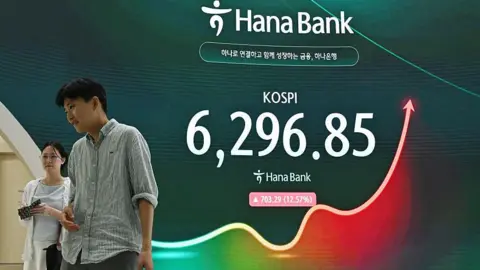
- South Korean shares jumped on Friday, partly reversing a three-day rout that wiped hundreds of billions of dollars off the value of the country's stock market; the benchmark Kospi index closed almost 18% higher.
- Asian stock markets rose on Friday, led by a sharp rebound in South Korean shares, after a strong Wall Street session and as investors digested the Bank of Japan’s rate decision and regional economic data.
- The Bank of Japan (BOJ) voted 8-1 to keep the uncollateralized overnight call rate at around 1.0%; board member Hajime Takata dissented in favor of 1.25%, citing upside risks to inflation.
- SK Hynix, a major supplier to leading artificial intelligence (AI) chip firm Nvidia, saw its shares gain almost 30%, while Samsung was up by 28%.
- The rally followed earnings updates from Amazon and Microsoft that boosted optimism over AI investment; Amazon jumped more than 9% in after-hours trading, while Microsoft gained more than 15%.
- South Korean regulators have announced measures aimed at curbing this week's sell-off.
- Surging chip stocks also helped push markets in Japan and Taiwan higher.
- Both firms had seen their stock market value slump this week as a sell-off in AI-related stocks deepened, and investors had become concerned over the hundreds of billions of dollars being poured into AI by big technology firms.
- Despite the rebound, the KOSPI remained on track for a 22% monthly drop amid profit-taking and AI-related worries.
South Korea's KOSPI index surged nearly 18% on Friday, recovering from a significant three-day decline that erased hundreds of billions in market value. This rebound was primarily fueled by strong performances from chipmakers SK Hynix and Samsung Electronics, which saw their shares rise by 30% and 28%, respectively.12614
The rally followed positive earnings reports from Amazon and Microsoft, which exceeded expectations and reignited investor confidence in AI-related investments. Amazon's stock jumped over 9% in after-hours trading, while Microsoft gained more than 15%, contributing to a broader optimism in the tech sector.789
Despite the gains, the KOSPI remains on track for a 22% monthly drop due to profit-taking and ongoing concerns regarding AI investments. South Korean regulators have also implemented measures to mitigate the recent sell-off, which had seen the tech-heavy index experience multiple circuit breaker halts this year.10
In the broader Asian market, stocks rose in response to the KOSPI's rebound, as investors also processed the Bank of Japan's decision to maintain interest rates at around 1.0%. The central bank's cautious stance reflects ongoing inflation risks and the impact of global economic conditions on Japan's economy.11
Overall, the market's recovery highlights the volatile nature of tech stocks amid fluctuating investor sentiment regarding AI and economic stability.
“SK Hynix, a major Nvidia supplier, surged almost 30% and Samsung gained 28%, lifting the KOSPI nearly 18% after the rout wiped hundreds of billions off the market. The index still faced a 22% monthly drop amid profit-taking and AI worries.”
 BBC
BBC



