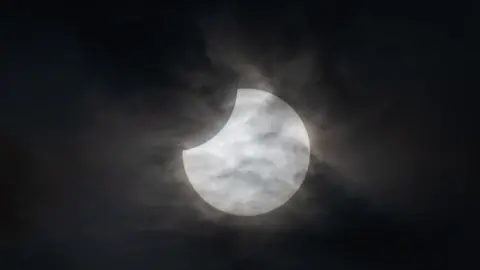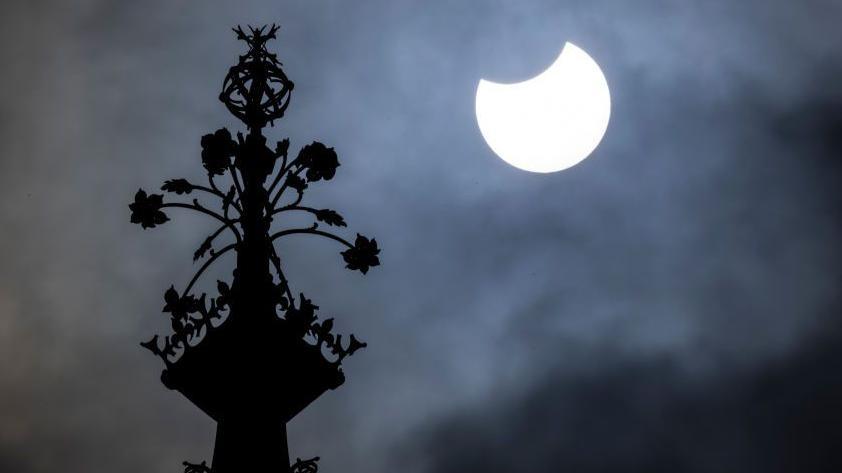
- On Wednesday 12 August, Londoners will see a rare partial solar eclipse, where the Moon moves between the Sun and the Earth, blocking the Sun's light partially.
- During this eclipse, around 90% of the Sun will be covered by the Moon for London viewers, the greatest coverage visible from the UK since 1999, according to Royal Museums Greenwich.
- The eclipse will begin at 18:17 BST with first contact, reach maximum at around 19:12 BST, and end at about 20:06 BST.
- The UK Health Security Agency warns that although the Sun may appear dimmer, looking directly can still cause serious damage to the retina.
- For safe viewing, Royal Museums Greenwich recommends ISO 12312-2 certified eclipse glasses; ordinary sunglasses are not safe because they do not provide enough protection against harmful solar radiation.
- Alternative viewing methods include making a pinhole projector or using a colander to see multiple projected images of the eclipse; for smartphone photos, use a solar filter or place eclipse glasses over the lens.
- Best viewing spots in London include Telegraph Hill, Primrose Hill, Parliament Hill, Alexandra Palace, Crystal Palace Park, and Greenwich Park, with higher points offering an uninterrupted view towards the west or west-north-west.
- Public viewing events include a session hosted by the Flamsteed Astronomy Society at the Royal Observatory (16:00–20:00), free sessions by the Croydon Astronomical Society and Loughton Astronomical Society, a meetup in Tooting Bec, and a live free stream from the Royal Observatory.
On Wednesday, August 12, London will witness a significant partial solar eclipse, with around 90% of the Sun covered by the Moon, marking the greatest coverage since 1999. The event will begin at 18:17 BST, peak at 19:12 BST, and conclude by 20:06 BST.123456
Royal Museums Greenwich emphasizes the importance of safe viewing, advising the use of ISO 12312-2 certified eclipse glasses to prevent retinal damage, as ordinary sunglasses are insufficient. They also provide instructions for creating a pinhole projector for indirect viewing.78910111213
Recommended viewing locations in London include Telegraph Hill, Primrose Hill, and Greenwich Park, with public viewing sessions hosted by the Flamsteed Astronomy Society at the Royal Observatory. The UK Health Security Agency warns that the eclipse can make the Sun appear dimmer, potentially leading to unsafe direct viewing.1415161718
Local astronomy groups, such as the Croydon Astronomical Society and SW London Stargazers Meetup, will also host free viewing events, ensuring that enthusiasts have ample opportunities to safely enjoy this celestial phenomenon.
“The eclipse will begin at 18:17 BST, peak at 19:12 BST, and end by 20:06 BST. The UK Health Security Agency warns that even a dimmer Sun can cause serious retina damage, so ISO 12312-2 certified glasses are essential.”