Sources: 

Scientists have identified a new class of worker honeybee, inspired by a toddler's curiosity. These workers are essential in constructing queen cells, crucial for the development of future queens.
Kai Wang of the Chinese Academy of Agricultural Sciences states, "We discovered that worker bees heat their thoraxes while building queen cells."
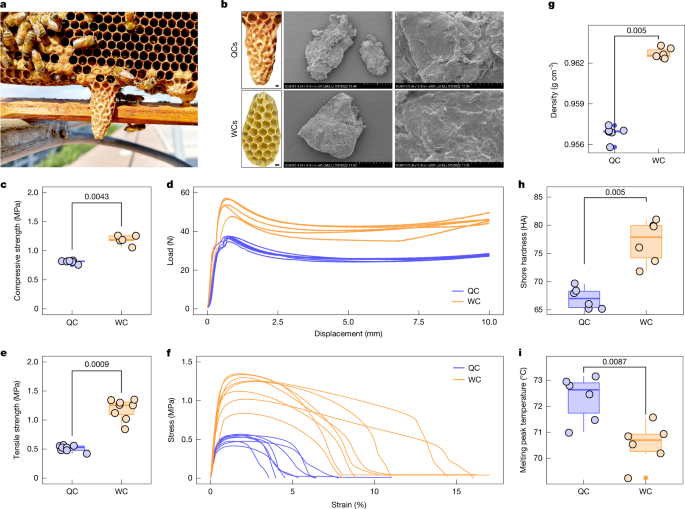
The architectural features of queen cells, specifically the unique properties of the wax used in their construction, have been shown to influence the survival and development of future queens. Analyses revealed queen-cell wax is softer, less dense, and chemically distinct from worker-cell wax, leading to significant differences in larval outcomes.
Up to two-thirds of larvae under worker-cell wax died, compared to only
roughly a third under queen-cell wax.
Wang emphasizes, "We often think we already know so much about honey bees, but their architectural behaviour goes far beyond our current understanding." This discovery indicates that the division of labor in bee societies is more complex than previously recognized, highlighting a direct link between the environment constructed by bees and the developmental plasticity of larvae.
Further research aims to clarify how these environments impact queen bee development, reinforcing the notion that
“bees do more than feed the queen — they actively engineer them.”Sources: 
Inspired by his toddler, bee expert Kai Wang discovered a new type of worker honeybee that plays a pivotal role in raising future queens, revealing that the architectural design of queen cells significantly influences larval development, a breakthrough that reshapes our understanding of bee biology.

 2
2