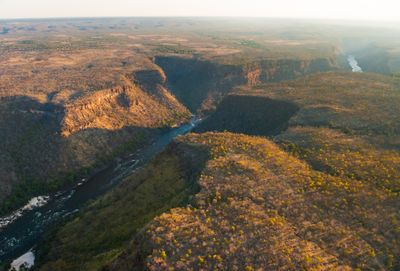
Scientists say first signatures of a potential new tectonic plate boundary are bubbling up in Zambia's Kafue Rift.

Recent findings from the Kafue Rift in Zambia suggest emerging signatures of a future tectonic split. Evidence indicates a connection between geothermal spring gases and deep Earth's mantle, hinting at active rifting.

Sources:
IFLScienceScienceAlert+1
Trending 1h ago
Tab background
Sources: IFLScienceScienceAlert
Scientists exploring Zambia's Kafue Rift have discovered helium isotopes in hot springs, suggesting a direct connection to the Earth's mantle. This finding indicates that the rift may be an active tectonic boundary, potentially linked to the larger Southwest African Rift System.
The researchers, led by Professor Michael Daly from the University of Oxford, sampled geothermal springs and found a helium-3 to helium-4 ratio indicative of mantle origins, which was observed to be seven times higher than in control wells.
"The hot springs along the Kafue rift of Zambia have helium isotope signatures which indicate that the springs have a direct connection with the Earth's mantle, which lies between 40 and 160km below Earth's surface," said Professor Daly.
The Kafue Rift forms part of a 2,500-kilometer-long rift system stretching from Namibia to Tanzania. The scientists suggest that if similar findings are confirmed along this extensional zone, it would provide further evidence for an emerging plate boundary capable of continental separation.
Daly cautioned, however, that this study is based on helium analyses from only one area of the Southwest African Rift System: "This is a large geological area, and not every rift forms a plate boundary."
This potential tectonic activity may signal the start of the break-up of sub-Saharan Africa, a significant geological event for the region.
Sources: IFLScienceScienceAlert
Scientists have identified possible early signs of a new tectonic plate boundary in Zambia's Kafue Rift, with helium isotope analysis from geothermal springs indicating a connection to the Earth's mantle. This could signal the beginning of a continental break-up in the region, stretching 2,500 kilometers across Africa.
Section 1 background
The Headline

New Tectonic Boundary Signs in Zambia

Key Facts
  • Researchers believe the Kafue Rift could be the site of the world’s newest plate boundary, as the once stable African tectonic plate shows signs of cracking.IFLScience
  • Evident signs of the new tectonic boundary have been found, with researchers indicating that the boundary cuts through the crust down to the mantle below, supported by gas analysis from hot springs along the rift.IFLScience
  • The helium-3 to helium-4 ratio discovered in geothermal springs and wells in Zambia suggests a composition more typical of the mantle than crust, indicating a significant geological process.IFLScience
  • Gas samples analyzed show that helium isotopes in the Kafue Rift region are comparable to those found in the East African Rift System, suggesting significant geological activity.1
  • Isotopic analysis reveals that the presence of helium in the hot springs is strong evidence of an active rift that may indicate the early stages of tectonic rifting in sub-Saharan Africa.ScienceAlert
Section 2 background
Other Updates

Additional Findings on Plate Boundary

Key Facts
  • Future findings along other segments of this rift system could further confirm the mantle connectivity, providing more evidence of an emerging plate boundary capable of separating the continent.ScienceAlert
Section 3 background
Background Context

Context: The Kafue Rift Explained

Key Facts
  • The Kafue Rift is part of a larger rift system stretching 2,500 kilometers (1,553 miles) across Africa, potentially extending towards the boundary between the African and South American Plates.ScienceAlert
  • Continental rifts, such as the Kafue, can evolve into significant geological formations, as indicated by Professor Michael Daly's research on the Great Rift Valley of Kenya, which offers compelling evidence for continental break-up.1
Article not found
CuriousCats.ai

Article

Source Citations