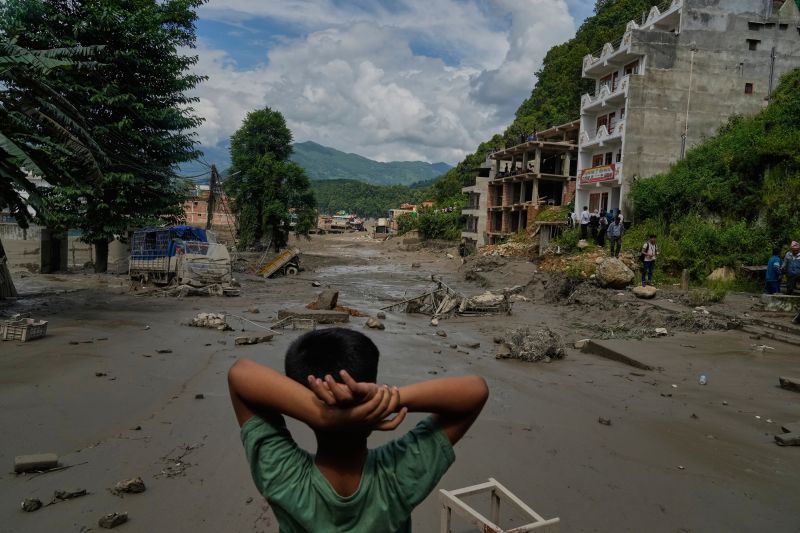
- At 8:37 a.m. local time, a 4.4 magnitude earthquake was reported by to have struck along the Nepal-China border, north of Kathmandu.
- Around the same time, an avalanche of ice and rock tore down a mountainside and into the Lhende Khola River, a tributary of the Bhote Koshi River.
- Satellite imagery suggests that no major lakes are upstream of the flood path, indicating that a glacial lake outburst can be excluded.
- Widespread intense rainfall hasn’t been observed near the area over the past week, according to a CNN Weather analysis of satellite and weather station data.
- Geologist Daniel Shugar suggests the earthquake may have been seismic energy released by the landslide, and warmer temperatures may have weakened the glacier and rocks.
Scientists are probing the recent floods in Nepal, attributing the disaster to a landslide rather than a glacial lake outburst. An earthquake, measured at 4.4 magnitude, likely released seismic energy from the landslide, which sent a massive volume of water into the Lhende Khola River.
“What is hard to reconcile is the gargantuan volumes of water that we see in these these absolutely horrific videos,” said Daniel Shugar, a geologist at the University of California. He noted that warmer temperatures may have contributed to the landslide by weakening the mountain rocks.56
According to Wolfgang Schwanghart, a geomorphology professor at the Freie Universität Berlin, satellite imagery indicates that no significant glacial lakes were upstream of the flood path, effectively ruling out a glacial lake outburst as a cause. Additionally, CNN Weather analysis found that widespread intense rainfall had not been observed in the area leading up to the floods, further supporting the landslide theory.
The combination of geological factors and seismic activity has raised concerns about the stability of the region, as experts continue to analyze the implications of these findings for future flood risks in Nepal.
“Satellite imagery shows no major lakes upstream, ruling out a glacial lake outburst, while CNN Weather analysis found no intense rainfall in the past week. Geologist Daniel Shugar says warmer temperatures may have weakened glacier and rock, allowing meltwater to seep into cracks and hasten the collapse.”