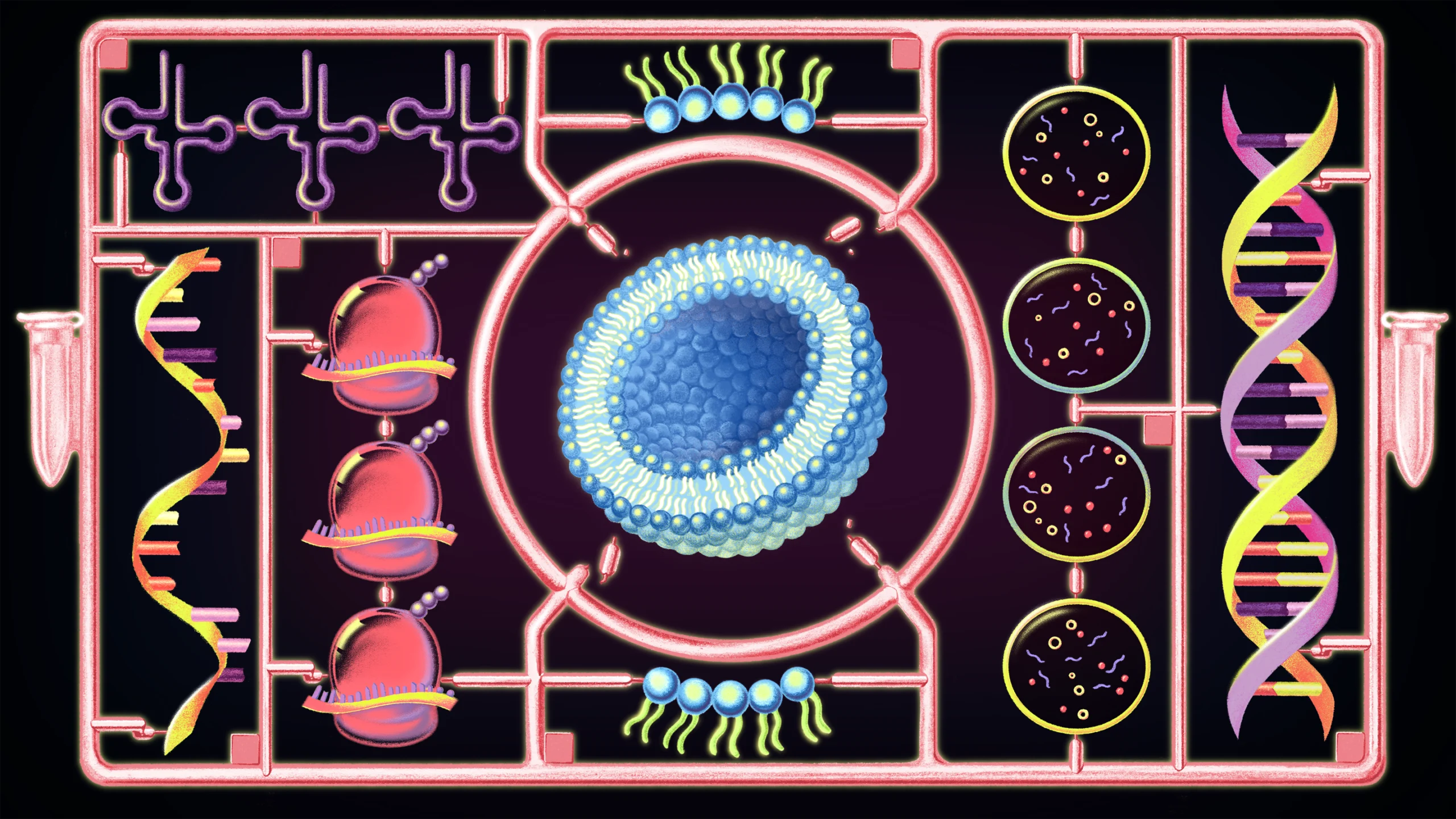
- Scientists have built a synthetic cell that combines more lifelike properties than ever before — proof of concept that it’s possible to bring nonliving materials to life, or something close to it, in the lab.
- The lab-made synthetic cell grew, replicated its DNA, and divided, demonstrating the basic functions of a cell cycle.
- This cell feeds, grows, and reproduces and is manmade, marking a significant advancement in synthetic biology.
- Dr. Kate Adamala, who led the research at the University of Minnesota, stated that the synthetic cell is not as robust as a natural cell but serves as proof of principle that molecules can reconstitute behaviors associated with living cells.
- SpudCell, as named by Dr. Adamala, is made up of 150 to 200 molecules and can replicate for about five generations.
- The synthetic cell's genome is significantly smaller than that of a natural cell, containing only 90,000 base pairs.
- Researchers blended together dozens of ingredients to synthesize simple cells that feed, grow, reproduce, and compete for food.
- Prof. Tom Ellis described the work as probably the field’s biggest breakthrough in recent times.
- Adamala and others are launching an institution called Biotic to pool global expertise and enhance the capabilities of SpudCells.
Scientists at the University of Minnesota have achieved a groundbreaking milestone in synthetic biology by creating SpudCell, a synthetic cell that can feed, grow, and reproduce.5
Constructed from 150 to 200 nonliving chemical components, SpudCell mimics basic cellular functions, including DNA replication and division, demonstrating the potential to create life from nonliving materials.
Dr. Kate Adamala, who led the research, emphasized that while SpudCell is not as efficient as natural cells, it serves as proof of principle that molecules can reconstitute behaviors associated with living cells.4
The synthetic cell operates in a nutrient-rich liquid and can replicate for about five generations, taking roughly 12 hours to do so at 30 degrees Celsius (86 degrees Fahrenheit).
“Making a synthetic cell helps us understand the exact minimum requirements for life,” said Prof. Tom Ellis from Imperial College London, who called the work a significant breakthrough.8
The research team has also shown that SpudCells can compete for resources, mimicking evolutionary processes.
“Life is not binary,” Adamala stated, highlighting the complexity of life creation.
The team plans to establish an institution called Biotic to further develop SpudCells and explore their applications in biofuels, drugs, and disease research.

“That’s the shake-the-ground accomplishment here,” said Dr. Zia, underscoring the importance of this research in understanding life’s origins.
Despite its limitations, SpudCell represents a significant step toward the long-sought goal of creating life from scratch.
“Researchers have successfully constructed a synthetic cell that mimics basic life functions, including feeding, growing, and reproducing. This breakthrough could pave the way for advancements in synthetic biology and understanding the origins of life.”
 Quanta Magazine
 The Guardian



