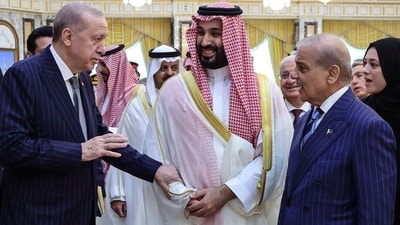
- Saudi Arabia, Turkey, and Pakistan have signed a mutual defense pact, marking a significant shift in the region's security dynamics.
- The maritime component of the new architecture includes Pakistan and Turkiye alongside 11 other states, safeguarding the Red Sea, Bab al-Mandeb, Strait of Hormuz, Arabian Sea and the Gulf coast to protect commercial and energy routes.
- The US-Iran war accelerated a transformation already under way, exposing the vulnerability of the US basing structure in the Gulf and forcing the repositioning of substantial combat forces, leading to the eventual closure of several American bases.
- While America is not disappearing from the Middle East, the war exposed the limits of American dominance, and regional states are now bound to organise their own security.
- Pakistan possesses the Muslim world’s most powerful army and its only nuclear arsenal, while Turkiye has the second-most powerful army, NATO experience, substantial naval power, and a sophisticated defence industry.
- Saudi Arabia provides complementary capability with the Royal Saudi Air Force becoming the Muslim world’s most powerful air force, centred on advanced 4.5-generation combat aircraft and sophisticated intelligence, command-and-control, air-defence and precision-strike capabilities.
- Pakistani forces are already deployed alongside Saudi forces and integrated into Saudi-led structures, while Islamabad has warned Tehran against coordinated attacks on Saudi Arabia’s principal strategic infrastructure.
- Saudi Arabia is the largest Arab and Middle Eastern economy, the world’s largest crude oil exporter, OPEC’s leader, and holder of the world’s greatest spare production capacity, making its petroleum infrastructure fundamental to the global economy.
A new mutual defense agreement signed in Mecca by Saudi Arabia, Turkey, and Pakistan signifies a pivotal shift in Middle Eastern security dynamics. This pact, which unites the three leading Sunni Muslim powers, establishes a framework where an attack on one member is considered an attack on all.1568
The agreement comes in the wake of the US-Iran conflict, which has highlighted the vulnerabilities of American military presence in the region. As a result, regional states are increasingly compelled to take charge of their own security arrangements. America's influence remains significant, but the limits of its dominance have been exposed, prompting a reorganization of regional power structures.4
Pakistan, with the Muslim world's most powerful army and nuclear arsenal, and Turkey, boasting NATO experience and a robust defense industry, complement Saudi Arabia's military capabilities. The Royal Saudi Air Force is now the most formidable air force in the Muslim world, equipped with advanced combat aircraft and sophisticated military technology.
The pact also includes a maritime component aimed at protecting critical shipping routes through the Red Sea, Bab al-Mandeb, and the Strait of Hormuz. This collaboration among 14 states, including Pakistan and Turkey, is designed to secure vital commercial and energy routes essential for the global economy.2
As Saudi Arabia continues to lead as the largest Arab economy and a key player in global oil markets, this new security architecture could reshape the geopolitical landscape of the Middle East for years to come.
“The pact leverages Pakistan's nuclear arsenal and Turkiye's NATO experience, while Saudi Arabia's air force becomes the region's most powerful. The maritime component, including 11 other states, will protect key energy routes through the Red Sea and Strait of Hormuz.”