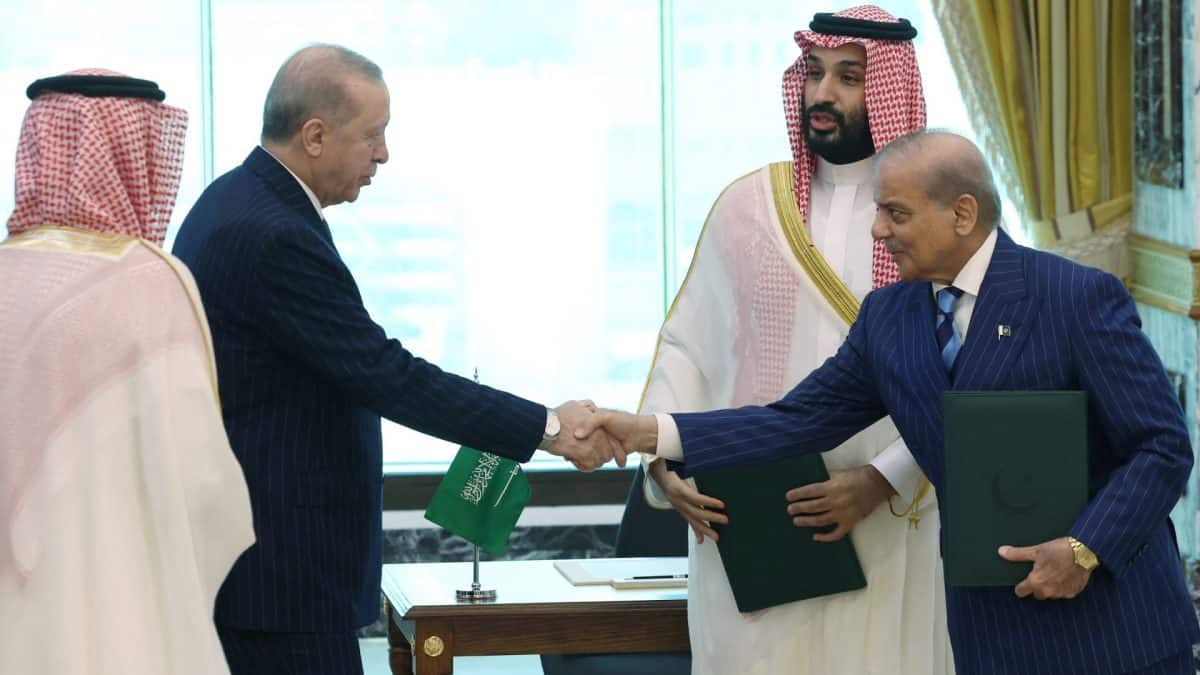
- On August 7, 2026, in the presence of Crown Prince Mohammed bin Salman, Saudi Arabia, Turkey and Pakistan signed the Mecca (Makkah) Joint Defence Agreement, a trilateral collective-defence compact declaring that an armed attack on any one of the three shall be treated as an attack on all.
- The pact builds on the September 2025 bilateral Saudi-Pakistan Strategic Mutual Defence Agreement, now widened to bring in Turkey’s Nato-integrated military machine and its formidable defence-industrial base.
- The framework is anchored in collective deterrence, joint military exercises, intelligence sharing, defence-industrial cooperation, and interoperability, described by its architects as “purely defensive” and open to future members, but conspicuously silent on any nuclear dimension.
- The pact is less a finished alliance and more a strategic hedge necessitated by the gross insecurity of Saudi Arabia in the ongoing war in West Asia, pooling reputational and military weight without building institutional scaffolding.
- The pact’s public scope covers four pillars: a collective-deterrence clause modelled on Article 51 of the UN Charter, joint training and military exercises, intelligence-sharing mechanisms, and defence-industrial integration, most visibly Turkish drone production tying into Saudi capacity.
- What is missing is equally instructive — no integrated command headquarters, no standing joint force, no common budget, and crucially, no explicit nuclear-sharing clause, a marked departure from speculation that surrounded the original bilateral Saudi-Pakistan text.
- A reported exclusionary clause limits obligations: a member that initiates aggression, or permits its territory to be used to attack another state, forfeits the pact’s protection.
- Comparisons to Nato are analytically loose; Nato’s guarantee rests on a standing treaty organisation, an integrated command structure, seven decades of tested doctrine, and an implicit nuclear umbrella, while the Mecca pact has none of this, leaving geographic scope and assistance triggers undefined.
Saudi Arabia, Turkey, and Pakistan have formalized their military cooperation with the Mecca Joint Defence Agreement, signed on August 7, 2026, in the presence of Crown Prince Mohammed bin Salman. This trilateral pact declares that an armed attack on any one of the three nations will be considered an attack on all.1
The agreement builds on the September 2025 bilateral Saudi-Pakistan Strategic Mutual Defence Agreement, expanding its scope to include Turkey's NATO-integrated military capabilities and defense-industrial base. The pact emphasizes collective deterrence, joint military exercises, intelligence sharing, and defense-industrial cooperation, particularly in Turkish drone production.28910
However, the agreement lacks certain structural elements typical of established military alliances. There is no integrated command headquarters, no standing joint force, and no common budget. Notably, it also omits an explicit nuclear-sharing clause, which had been speculated in earlier discussions.
A reported exclusionary clause states that a member initiating aggression or allowing its territory to be used for attacks forfeits the pact's protection. This arrangement is seen as a strategic hedge for the three nations, particularly for Saudi Arabia amid ongoing regional insecurities.4
Officials have confirmed that the agreement is anchored in a collective-deterrence clause modeled on Article 51 of the UN Charter, rather than a bespoke treaty formula, indicating a cautious approach to future military collaboration.
“The pact's four pillars include a collective-deterrence clause modelled on Article 51 of the UN Charter, joint exercises, intelligence sharing, and defence-industrial integration, notably Turkish drone production. However, it lacks an integrated command, standing force, common budget, and any nuclear-sharing clause, with an exclusionary clause stripping protection from aggressors.”
 Firstpost



