
- Researchers have discovered salty clouds surrounding the universe's famous "Pink Planet" GJ504b using the James Webb Space Telescope.
- This discovery provides direct evidence for salt clouds in a cold object's atmosphere, a phenomenon theorized over 15 years ago.
- GJ504b, with a temperature of 550 degrees Fahrenheit (290 degrees Celsius), is considered one of the coldest objects ever studied.
- The study estimates that GJ504b is between 2.5 billion and 4 billion years old and has a mass around 25 times that of Jupiter.
- The observations revealed a rich mix of chemicals, including water vapor, methane, carbon dioxide, and ammonia.
- Salt clouds were found to be critical in explaining the spectrum of GJ504b, affecting the light detected by the telescope.
- GJ504b, also known as the Pink Planet, was discovered in 2013 and is technically a planetary-mass companion orbiting a star in the constellation Virgo.
- The James Webb Space Telescope made it possible to detect these clouds, which were previously difficult to observe from ground-based instruments.
Researchers using the James Webb Space Telescope have made a groundbreaking discovery surrounding GJ504b, the so-called Pink Planet, located 57 light-years from Earth.1891011
They found salty clouds in its atmosphere, challenging previous assumptions about such celestial bodies.
GJ504b, with a temperature of 550°F (290°C), is not a planet but a planetary-mass companion, possibly a giant exoplanet or a small brown dwarf.
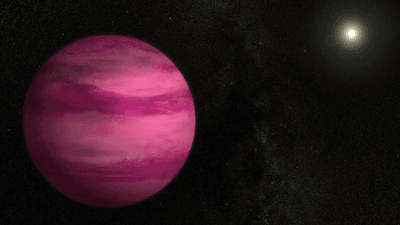
Discovered in 2013, it is estimated to be between 2.5 billion and 4 billion years old and has a mass around 25 times that of Jupiter.45
The new observations revealed a rich mix of chemicals, including water vapor, methane, carbon dioxide, and ammonia.6
According to Aneesh Baburaj, the study's leader, the presence of salt clouds was critical in explaining the spectrum of GJ504b.7
"We tried three different types of clouds, and salt clouds fit best. When we accounted for salt clouds, it subdued the signature of molecules hidden deeper in the companion’s atmosphere," Baburaj stated.
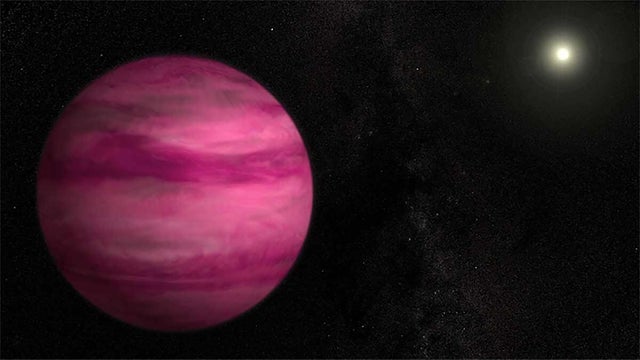
This discovery provides some of the first direct evidence for salt clouds in a cold object's atmosphere, a phenomenon theorized for over 15 years.2
The researchers were surprised by the ease of detection with the Webb telescope, which took only two hours to capture the faint light of the Pink Planet, creating a light "fingerprint" that revealed its atmospheric composition.
Baburaj noted, "We will be able to detect colder and colder objects, and a lot of these objects might have these higher metal-to-hydrogen ratios compared to our sun."
“The James Webb Space Telescope has revealed that the Pink Planet GJ504b is surrounded by salty clouds, a phenomenon theorized for over 15 years. This discovery provides critical insights into the atmospheric composition of cold celestial objects.”
 IFLScience
 CBS News