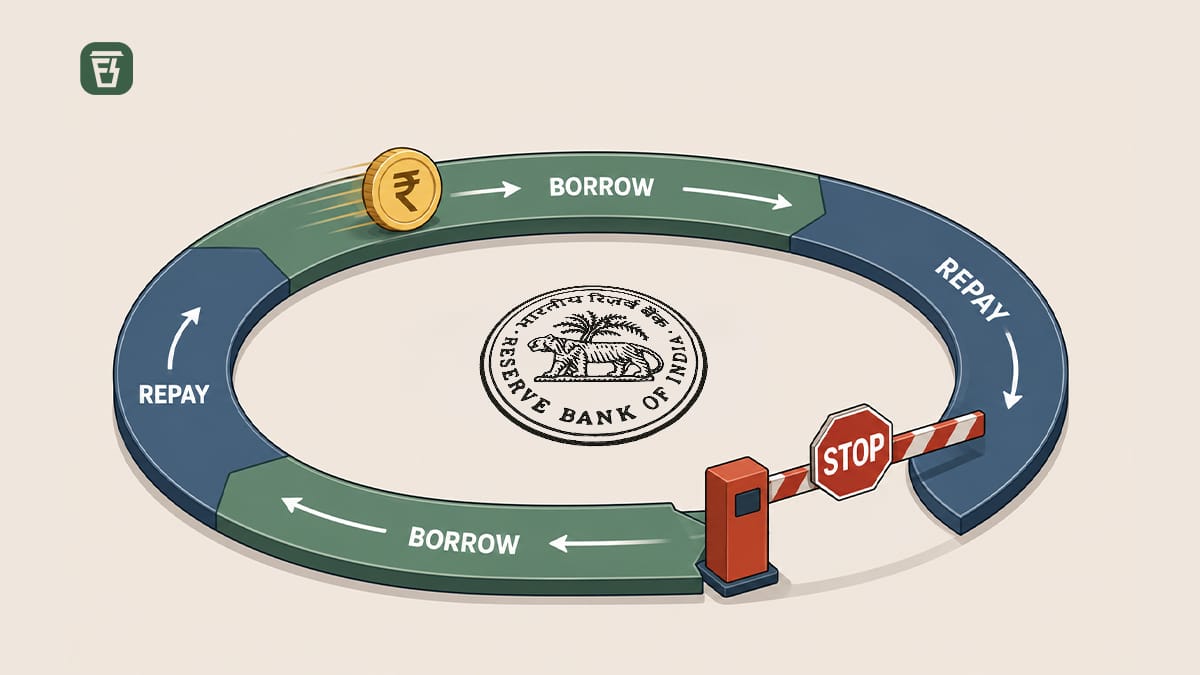
- The Reserve Bank of India (RBI) is sceptical of certain forms of revolving credit offered by non-bank entities, particularly where repayment patterns could conceal a rise in household indebtedness.
- The RBI’s attempt to restrict the revolving credit offered by non-banking financial companies (NBFCs) shows its legitimate concern as the regulatory body needs to tread a delicate balance between financial inclusion and financial stability.
- Rising concerns around unsecured retail credit and potential debt cycles prompted the RBI to seek amendments, considering that Kisan Credit Cards (KCC) and such other instruments are essential for growth, but it viewed that unchecked and easy accessibility through digital platforms and consumer finance channels could expose it to more vulnerabilities.
- Apprehensive of evergreening, the RBI repeatedly flagged the rapid growth of unsecured retail credit, particularly through fintech–NBFC partnerships, offering high-risk loan products as revolving credit lines.
The Reserve Bank of India (RBI) is re-evaluating its regulations on revolving credit provided by non-banking financial companies (NBFCs) amid escalating concerns regarding household debt and financial stability.12
The RBI's scrutiny arises from the rapid growth of unsecured retail credit, particularly through partnerships between fintech firms and NBFCs, which have introduced high-risk loan products. Apprehensive of evergreening, the RBI has flagged the potential for these credit lines to mask rising household indebtedness, leading to a cycle of debt for consumers.34
The central bank's initiative to restrict such credit offerings reflects its need to balance financial inclusion with the imperative of maintaining financial stability. RBI's attempt to restrict the revolving credit shows its legitimate concern as it seeks to amend regulations to mitigate risks associated with unsecured retail credit. The RBI acknowledges that while instruments like Kisan Credit Cards (KCC) are vital for growth, the unchecked accessibility of credit through digital platforms poses significant vulnerabilities.
As the RBI navigates these challenges, it aims to ensure that the financial ecosystem remains robust while protecting consumers from potential pitfalls associated with easy credit access.
“The RBI's scrutiny of unsecured retail credit is driven by fears of potential debt cycles, prompting a call for amendments to ensure financial stability. Additionally, the rapid growth of high-risk loan products through fintech–NBFC partnerships has raised alarms about evergreening practices.”







/greater-kashmir/media/media_files/wp-content/uploads/2024/12/Income-Tax-Dept.jpg)