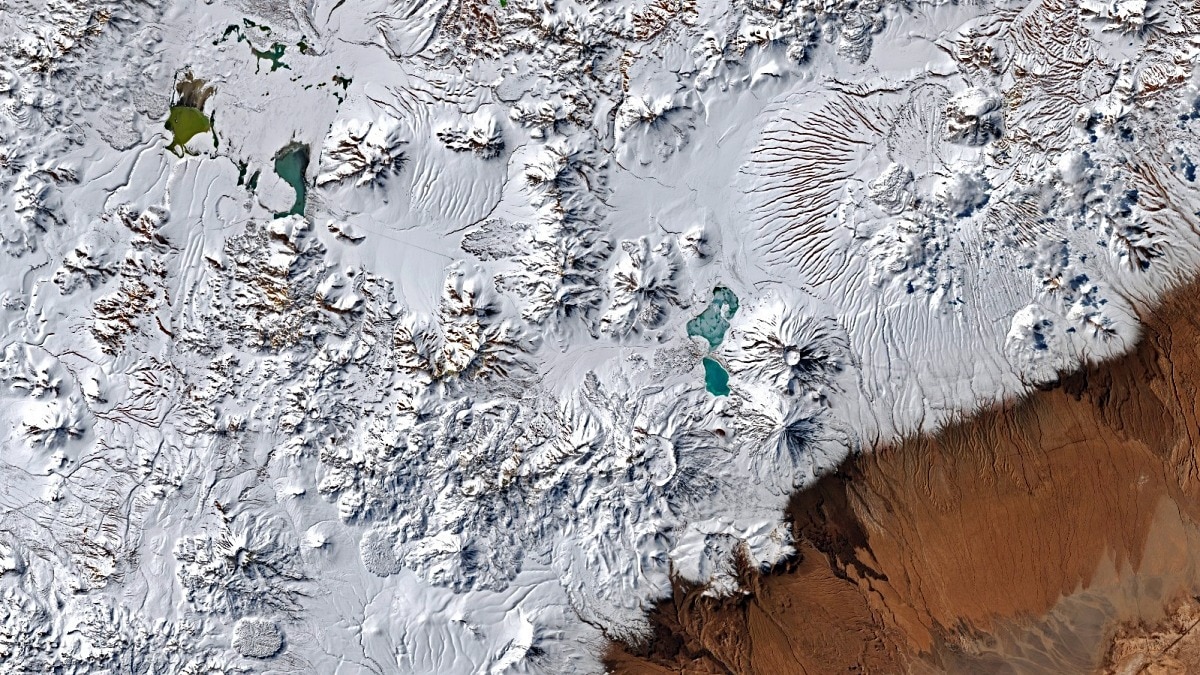
- Rare, widespread snow covered one of the most notoriously dry places on Earth, leaving it looking like a winter wonderland.
- A winter storm brought about the dramatic change between the first photo taken on Aug. 6 and the second taken on Aug. 14.
- Another winter storm passed through on Aug. 19, blanketing an even wider area with fresh snowfall.
- Heavy snow and strong winds forced ALMA to suspend operations and place its antennas in a protective mode.
- A second storm later in August spread snow much farther west, approaching the Pacific coast near Antofagasta.
- In Taltal, nearly 40 mm of rain fell over three days, roughly 10 times the city's average annual rainfall.
- The unusual rains triggered a massive wildflower bloom across the desert in August 2026.
- Although the Atacama Desert is typically dry, the region has seen snow before, most notably in 2025 and 2011, but it is not a frequent occurrence.
- The 2026 event stands out for its sheer reach, showing how even Earth's most reliably dry landscapes can occasionally be transformed by an unusual combination of cold air, moisture and atmospheric circulation.
Rare winter storms have transformed Chile's Atacama Desert, typically known for its aridity, into a snowy landscape. The storms, occurring in August 2026, stretched from the Andes to the Pacific coast, marking a significant meteorological event for the region.
The first storm brought snow on August 6, with subsequent storms on August 14 and August 19 expanding the coverage. NASA satellite images revealed the stark contrast of the desert's usual barrenness now blanketed in white.
Historically, the Atacama has seen snow infrequently, with notable occurrences in 2011 and 2025. However, the 2026 event stands out for its extensive reach, affecting areas that typically remain dry. The storms were linked to a cutoff low and an exceptionally large trough in the Southern Hemisphere, allowing moisture to penetrate the region.9
In Taltal, nearly 40 mm of rain fell over three days, approximately 10 times the city's average annual rainfall. This influx of moisture is expected to trigger a massive wildflower bloom across the desert, showcasing nature's resilience.7
The Atacama Large Millimeter/submillimeter Array (ALMA), a major astronomical observatory, had to suspend operations due to heavy snow and strong winds, highlighting the storms' impact on local infrastructure.4
The strengthening El Niño phenomenon has also played a role, weakening the subtropical high-pressure system that usually keeps the Atacama dry, thus shifting storm tracks closer to the region.
This rare weather event illustrates how even the driest landscapes can be dramatically altered by unusual atmospheric conditions.
“The storms, linked to a cutoff low and a strengthening El Nino, brought nearly 40 mm of rain to Taltal—about 10 times its annual average—and forced ALMA to suspend operations. The moisture also triggered a massive wildflower bloom across the desert in August 2026.”