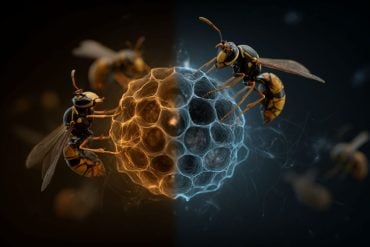
Queenless wasp colonies face chaos; Non-fighting 'compensator' wasps step up to keep them running amid turmoil.

Following the loss of a queen, tropical paper wasp colonies descend into chaos as females compete for dominance. However, compensator wasps maintain vital functions, such as foraging and brood care, allowing the colony to survive.

Sources:
ScienceDailyNeuroscience News+1
Trending 45m ago
Tab background
Sources: Neuroscience News
After a queen wasp's disappearance, tropical paper wasp societies experience immediate social breakdown, igniting fierce battles among workers.
However, some individuals, dubbed ‘compensators,’ refuse to engage in conflict, instead enhancing their efforts in critical tasks like foraging and caring for the brood.
Researchers from UCL detail that despite chaos, these compensators stabilize colonies by absorbing the costs of aggression.
They found that the compensators exhibit no biological differences from their fighting peers but significantly increase productivity in response to turmoil, keeping the colony functional.
This study challenges the long-held idea that cooperation in animal societies requires strict rules for stability. Instead, it shows that aggression-based succession can sustain colonies if some members are willing to mitigate the consequences.
The research presents a new perspective on how social systems can maintain functionality through adaptive strategies in the face of upheaval, revealing insights into the complexities of cooperation.
Ultimately, this dynamic indicates that even in the midst of conflict, the infrastructure of these societies remains intact, driven by the selfless actions of a few workers.
The findings emphasize the resilience and adaptability of Polistes canadensis and offer broader implications for understanding cooperation in animal societies.
Sources: ScienceDailyNeuroscience News
When queen wasps vanish, chaos ensues as workers battle for dominance. However, non-fighting 'compensator' wasps step in to gather food and care for young, allowing the colony to endure despite the social turmoil, according to findings from UCL researchers studying tropical paper wasps (_Polistes canadensis_).
Section 1 background
The Headline

Chaos in Queenless Wasp Colonies with Compensators

Key Facts
  • Queenless wasp colonies erupt into chaos when a queen disappears, leading to aggressive battles among female wasps for power.ScienceDaily
  • This power struggle causes the colony's normal social order to unravel amid a frenzy of aggression.
  • Compensator wasps emerge as unsung heroes during this turmoil, stepping up to gather food and care for the young instead of engaging in fights.ScienceDaily
  • Research indicates that these compensators increase their investment in foraging and brood care when the queen is lost.Neuroscience News
  • Despite intense conflict, the colonies can survive due to the efforts of these compensators, who do not engage in the political fighting.Neuroscience News
Section 2 background
Background Context

Context on Wasp Society Cooperation

Key Facts
  • Cooperation in wasp societies undergoes redistribution during turmoil instead of being lost entirely.ScienceDaily
  • The research focuses on tropical paper wasps (Polistes canadensis), which face immediate social breakdown and aggressive civil warfare after the queen's removal.Neuroscience News
  • Compensators show no distinct biological differences from those engaging in civil warfare, indicating that they are capable of supporting the colony without direct competition.Neuroscience News
  • This study challenges the classic evolutionary belief that cooperative animal societies must rely on orderly systems to remain stable, demonstrating the viability of aggression-based succession.Neuroscience News
Article not found
CuriousCats.ai

Article

Source Citations