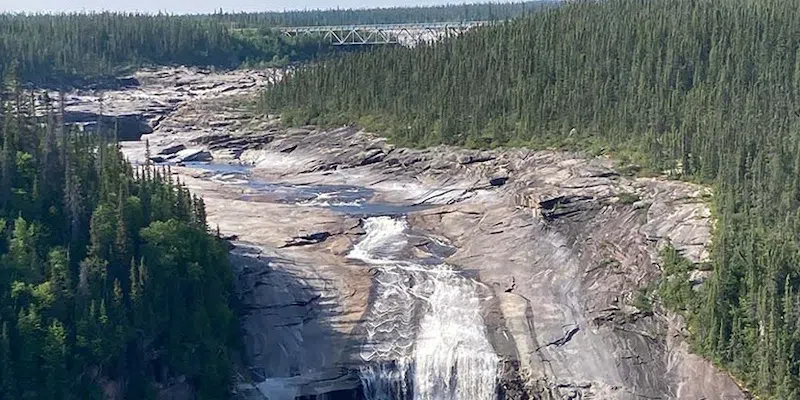
- The province and Newfoundland and Labrador are nearing a new agreement over the hydro development of Churchill Falls.
- While details of the agreement are sparse, both provinces confirmed Thursday that progress has been made in talks.
- Sources confirmed a new deal is being finalized, with two or three issues outstanding but close to resolution, and a formal announcement is expected early next week.
- The revamped Churchill Falls deal guarantees 985 megawatts of transmission access through Quebec, a significant change from the previous proposal which had zero megawatts.
- Quebec Premier Christine Fréchette said reaching a deal is a matter of long-term energy security for Quebec, and that discussions have accelerated recently, making her confident a deal could be signed soon.
- This guaranteed transmission access means Newfoundland and Labrador would have access to that power to use as it wishes.
- Ron Penney, a former deputy minister of justice and Muskrat Falls critic, called the potential transmission access a "big change" and "very advantageous" to the province.
- Premier Tony Wakeham has emphasized that the deal must be best for the province, stating his focus is on ensuring Newfoundlanders and Labradorians are the primary beneficiaries of their resources.
- Penney noted political pressures on Fréchette due to an upcoming election (to be called by Aug. 29) and on Newfoundland and Labrador due to the need for immediate cash from the previous MOU.
- Penney cautioned against celebrating prematurely, noting the PQ opposes the existing MOU and that negotiations cannot occur during an election, making the deal's future uncertain.
Quebec and Newfoundland and Labrador are close to finalizing a new agreement regarding the Churchill Falls hydroelectric project, which would ensure 985 megawatts of transmission access through Quebec.1569
Both provinces confirmed that discussions have accelerated, with Quebec Premier Christine Fréchette expressing confidence in reaching a deal soon. “The discussions have really accelerated in recent days, and that makes me very confident that we could reach a deal and sign something in the near term,” she stated.78
The revamped agreement marks a significant shift from the previous contract, which provided no guaranteed transmission access. “It would be a big, a big change, no question and very advantageous to us,” said Ron Penney, a former deputy minister of justice and critic of the Muskrat Falls project.
The urgency for a deal is underscored by political pressures, particularly for Fréchette, who faces an election deadline by August 29. “There was quite a bit of pressure on her,” Penney noted, highlighting the need for immediate cash flow for Newfoundland and Labrador under the previous memorandum of understanding (MOU).1314
Despite the optimism, Penney cautioned against premature celebration, citing potential political shifts in Quebec that could affect the agreement's future. “I don't think we should celebrate too much even if the deal is signed because the polls show that the PQ is going to be the next government in Quebec and they oppose the existing MOU,” he warned.
With two or three issues still outstanding, both governments aim for a formal announcement early next week, signaling a potential new chapter in the Churchill Falls saga.34
“Premier Tony Wakeham has stressed that Newfoundlanders and Labradorians must be the primary beneficiaries of their resources, while Quebec Premier Christine Fréchette cites long-term energy security. Ron Penney warns political pressures, including an upcoming Quebec election and PQ opposition to the existing MOU, could still derail the deal.”