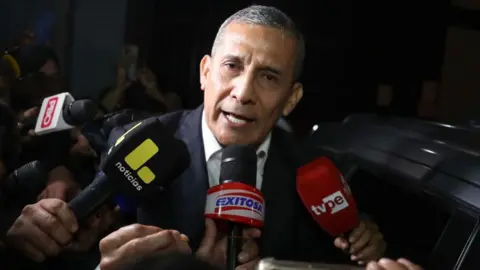
- Ollanta Humala, the former president of Peru, was released from Barbadillo Prison in Lima on Friday night after the Constitutional Court overturned his 15-year conviction for money laundering.
- The Constitutional Court ruled on July 15 that the criminal proceedings against Humala were null and void, stating that campaign contributions did not constitute money laundering at the time they were received.
- Humala and his wife were accused of receiving $3 million from Odebrecht and $200,000 from Venezuelan President Hugo Chávez for their presidential campaigns.
- Humala's lawyer stated that the court's decision indicated that the contributions received during electoral campaigns do not constitute money laundering.
- Humala was convicted in 2025 of money laundering and sentenced to 15 years in prison, marking a significant moment in Peru's ongoing struggle with corruption.
- The case against Humala is part of a broader investigation into Odebrecht's operations across Latin America, which has implicated numerous political figures in corruption scandals.
- Humala's legal troubles began shortly after his presidency ended in 2016, when Odebrecht admitted to bribing officials across Latin America.
Ollanta Humala, Peru's former president, was released from prison after the Constitutional Court overturned his 15-year conviction for corruption. The court ruled that the campaign contributions he received from Odebrecht and Hugo Chávez did not constitute money laundering, declaring the entire criminal proceedings null and void.1234
Humala, who served from 2011 to 2016, was convicted in 2025 for accepting illegal funds to finance his presidential campaigns in 2006 and 2011. His release on Friday night was met with cheers from supporters outside Barbadillo Prison in Lima. His lawyer, Julio Espinoza Goyena, stated that the court's decision confirmed that the contributions did not amount to money laundering.79

Upon his release, Humala expressed that he and his wife, Nadine Heredia, had been victims of political persecution. Heredia, who was also convicted, is currently in Brazil after being granted asylum. Humala's legal troubles began after Odebrecht admitted to bribing officials across Latin America, including $29 million in bribes to Peruvian officials between 2005 and 2014.
The court's ruling, published on July 15, found that Humala's conviction was based on conduct that was not legally defined as money laundering at the time of the alleged offenses. This decision aligns with previous rulings against other political figures, including Keiko Fujimori, who faced similar allegations.
Humala's case is part of a broader investigation into corruption linked to Odebrecht, which has implicated numerous former leaders in Peru. The former president's release marks a significant moment in the ongoing saga of political corruption in the country.
“The court ruled the contributions did not constitute money laundering when they were received, and Humala's lawyer Julio Espinoza Goyena called for definitive dismissal of the proceedings. His wife, Nadine Heredia, who was also sentenced to 15 years, remains in Brazil after being granted asylum.”
 BBC
BBC



