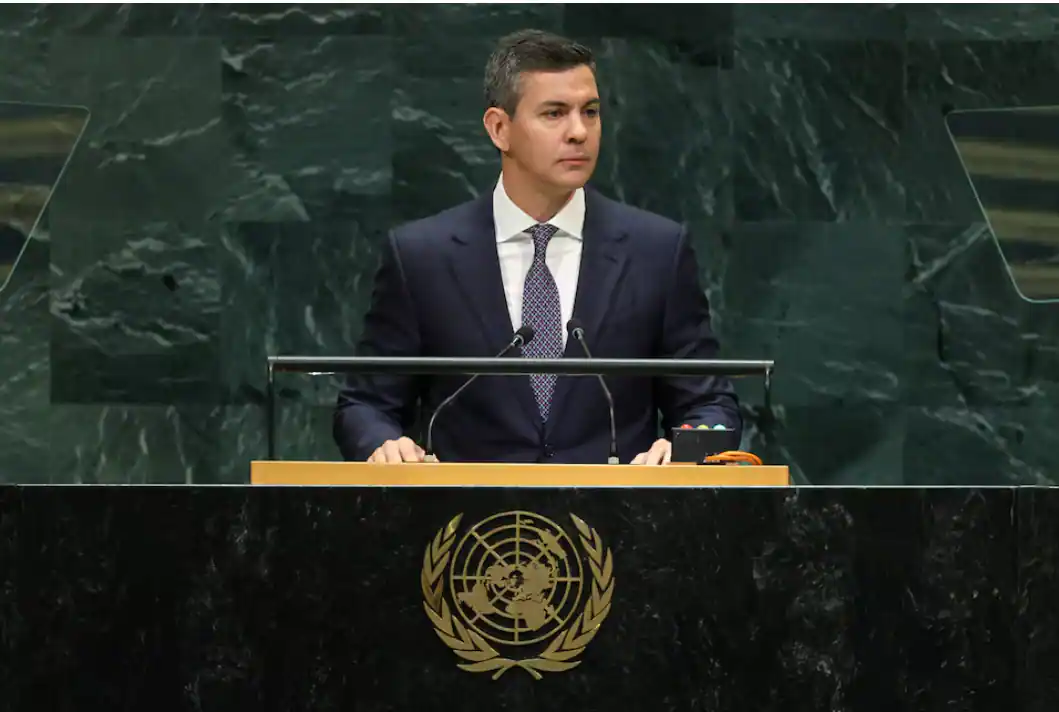
- President Santiago Peña resigned on Thursday amid a political crisis triggered by the collapse of Ueno Bank, which left millions of customers unable to access their funds.
- Peña stated, “I do so with the stability of our country, social peace, and the need to preserve our public institutions in mind,” in a message posted on social media.
- The Chamber of Deputies voted unanimously to trigger impeachment proceedings against Peña shortly after his resignation.
- Ueno Bank's solvency ratio fell below 50% of the required minimum, prompting the Central Bank of Paraguay to intervene and freeze customer savings.
- Eight Ueno executives were issued arrest warrants and later turned themselves in, with some placed under house arrest.
- The central bank chief resigned on Tuesday following the bank's collapse, which has left millions without access to their accounts.
- Peña faced accusations of conflicts of interest and misuse of pension funds linked to Ueno's collapse.
- Ueno Bank expanded rapidly from a niche fintech player to a mid-tier bank managing approximately $850 million in public funds.
- The crisis has undermined Paraguay's reputation as a stable destination for foreign investment, particularly from Brazil.
Paraguayan President Santiago Peña resigned on Thursday following the collapse of Ueno Bank, which left nearly half the population without access to their accounts. The crisis, triggered by the bank's insolvency, has led to impeachment proceedings against Peña, who is accused of dereliction of duty and conflicts of interest.1
In a recorded address, Peña stated, “I have made the decision to submit my resignation from the Presidency of the Republic. I do so with the stability of our country, social peace, and the need to preserve our public institutions in mind,” highlighting the turmoil surrounding his administration. The Central Bank of Paraguay intervened after determining Ueno Bank's solvency ratio had fallen below 50% of the required minimum, affecting 2.9 million customers in a nation of 6.5 million.4

The Chamber of Deputies voted unanimously to initiate impeachment proceedings shortly after Peña's resignation, with lawmakers accusing him of “serious and systematic dereliction of duty”. The opposition has called for accountability, with protests demanding Peña's removal. “He is accused of negligence at the very least and complicity in covering up the fact that the bank was insolvent,” said Al Jazeera’s Latin America editor Lucia Newman.3
The fallout from Ueno's collapse has also led to the resignation of Paraguay's central bank chief and the detention of eight bank executives. As the crisis unfolds, Peña's decision to step down must be ratified by the Senate, which is expected to act swiftly to ensure a smooth transition of power.
Peña, who took office in August 2023, has faced mounting pressure from both the opposition and members of his own party, further complicating the political landscape in Paraguay.
“The Central Bank of Paraguay found Ueno's solvency ratio fell below 50% of the required minimum, triggering a freeze on accounts of roughly 3 million customers, nearly half the population. Eight executives were detained, and lawmakers accused Peña of conflicts of interest and cover-ups linked to the bank's collapse.”