- Creating this robot took two years.
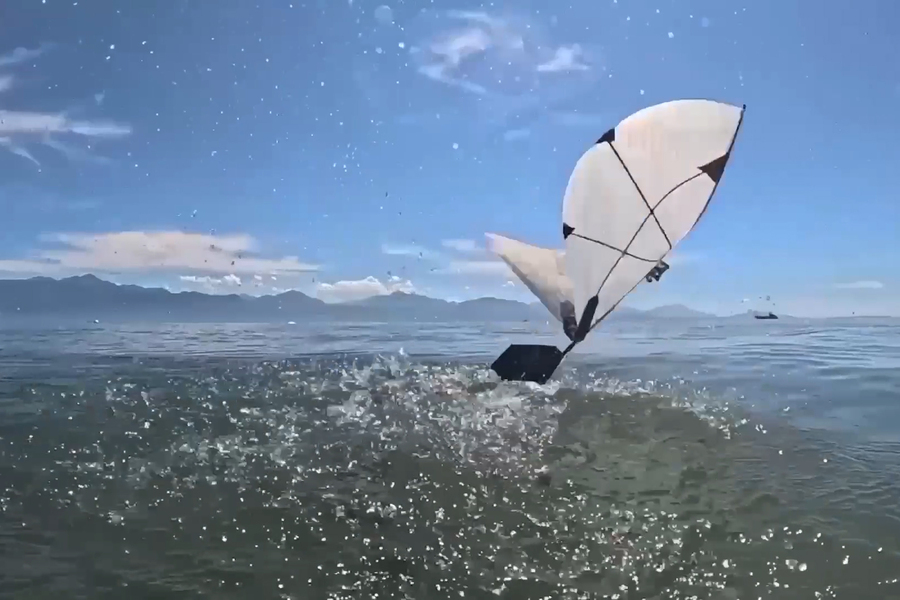
- Scientists tested their aerial-aquatic flying robot in Lake Geneva, proving that it had enough speed and power to lift itself out of the water with its wings alone.
- The robot could fly to the reef — or something else like a pod of whales or an algal bloom — and then sample the water and collect data.
- FAAV — the “flapping-wing aerial-aquatic vehicle” — weighs less than 300 grams and is designed to help scientists study the mechanics that enable diving birds to fly through air and water.
- The hardest thing FAAV does is the water-to-air transition, which had never been achieved by a bird-scale machine before.
- FAAV can swim underwater at nearly one m/s and cruise through the air at approximately 6.3 meters per second.
- On a single charge, the robot could fly for not quite four miles or swim for a bit more than a mile.
- FAAV's design could lead to a new class of aerial-aquatic vehicles for ocean exploration.
Engineers at MIT have unveiled the FAAV, or flapping-wing aerial-aquatic vehicle, a groundbreaking robot that weighs less than 300 grams and mimics the flight mechanics of diving birds.4
The FAAV is designed to transition seamlessly from swimming to flying without the need for paddling feet, a feat that has eluded previous designs. It can cruise through the air at approximately 6.3 meters (20.7 feet) per second and swim underwater at nearly one m/s (3.2 feet).

“The hardest thing FAAV does — and the reason a bird-scale machine had never done it before — is the water-to-air transition,” said Raphael Zufferey, assistant professor of mechanical engineering at MIT. The robot achieves this transition in less than a second with about 8 to 10 wing strokes, maintaining an efficient flapping rhythm.5
The design process took two years, and the FAAV has been tested in various environments, including Lake Geneva, where it demonstrated its ability to lift itself out of the water using its wings alone. On a single charge, it can fly approximately six kilometers (3.7 miles) or swim about two kilometers (1.2 miles).7
The researchers envision deploying these robots for oceanographic studies, allowing scientists to sample areas that are otherwise too dangerous for traditional vessels. “Our dream vision is for oceanographers, marine biologists, and members of coastal communities to launch this robot from a boat, or from shore,” Zufferey added, highlighting its potential applications in monitoring marine environments.
The FAAV's innovative design could pave the way for a new class of aerial-aquatic vehicles, enhancing our understanding of coastal ecosystems.
“The FAAV, weighing 250 grams, can fly approximately 6 kilometers (3.7 miles) or swim about 2 kilometers (1.2 miles) on a single charge. Researchers believe this technology could enable oceanographers to access dangerous aquatic regions for sampling and monitoring.”
 NPR
NPR ZME Science
 MIT News



