- New research suggests that Uranus and Neptune may not be the ice giants we imagined, as they might have a magma ocean brewing on the inside.
- The study indicates that the interior structure of Uranus and Neptune could provide insights into sub-Neptune exoplanets in the galaxy.
- The model that best fits the planets' properties suggests they have a well-mixed magma ocean with dissolved hydrogen at the bottom and a hydrogen-dominated envelope at the top.
- This mixing might help explain the planets' density, which has traditionally been interpreted as evidence for an ice-rich interior.
- The study concludes that the interiors of Uranus and Neptune are potentially comprised of a magma ocean, rather than an icy composition.
- Uranus and Neptune remain two of the most mysterious objects in the solar system, primarily because they’ve only been visited by NASA’s Voyager 2 spacecraft in 1986 and 1989, respectively.
- The study notes that while this is just one of a number of models, it has several aspects to recommend it.
- One aspect is the connection with other gas dwarf planets; it is unclear if ice giants and sub-Neptunes should be fundamentally different due to their distances from their host star.
New research suggests that Uranus and Neptune, traditionally classified as ice giants, may actually harbor magma oceans instead of icy interiors. This groundbreaking study challenges the long-standing belief that these planets are rich in ice, proposing a new model for their internal structure.15
The researchers found that the model which best fits the properties of Uranus and Neptune indicates a well-mixed magma ocean with dissolved hydrogen at the bottom and a hydrogen-dominated envelope at the top. This finding could help explain the planets' densities, which have been interpreted as evidence of an ice-rich composition.3
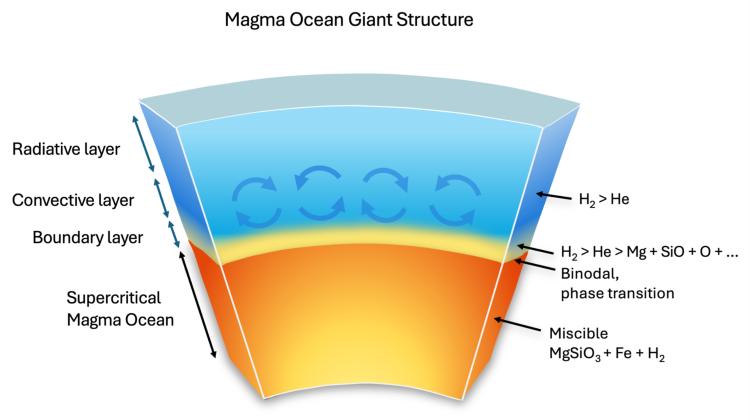
Uranus and Neptune remain two of the most enigmatic bodies in our solar system, having only been visited by NASA's Voyager 2 spacecraft in 1986 and 1989, respectively. The study emphasizes that while this is just one of several models that can reproduce the observed features of these planets, it has significant implications for understanding sub-Neptune exoplanets as well.2
The conclusion of the study states, “While this is just one of a number of models that successfully reproduce the observed features of Neptune and Uranus, this model has several aspects to recommend it.” The researchers argue that it is unclear whether ice giants and sub-Neptunes should be fundamentally different based solely on their distances from their host stars.7
“A new study indicates that Uranus and Neptune might possess magma oceans rather than icy interiors. This finding could provide insights into the structure of sub-Neptune exoplanets in the galaxy.”




