 EarthSky
- New research suggests Earth may survive the Sun's red giant phase after all, according to a study published in Astronomy & Astrophysics.
- The fate of Earth hinges on the Sun's mass loss rate during its final stages, which affects its gravitational pull.
- Lower tidal dissipation may allow Earth to drift outward instead of being swallowed by the expanding Sun, as new modeling suggests.
- If the Sun's mass loss predominates, Earth could escape into an orbit larger than the radius of its star.
- Mercury and Venus will be swallowed by the expanding Sun, but Earth and Mars have a good chance of surviving.
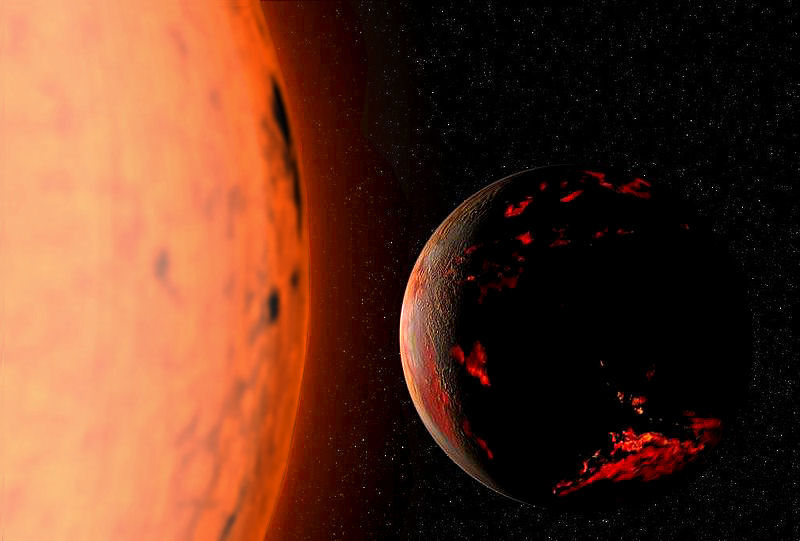
- About 5 billion years from now, our Sun will expand into a red giant, which has raised concerns about Earth's fate.
- Earlier studies had suggested that Earth won’t survive the swelling red giant Sun, but new findings provide a more optimistic outlook.
- The critical factor in determining Earth's fate is the equilibrium between tidal forces pulling it inward and the outward orbital shift caused by the Sun's mass loss.
- Data from L2 Puppis, a star with similar mass to the Sun, suggests that Earth will move far enough outward to survive both the red giant phase and the subsequent asymptotic giant branch phase.
- Current observations indicate that Earth will survive, but more precise observations are needed to confirm this prognosis.
New research from the University of Leuven and CEA Paris-Saclay suggests that Earth may survive the Sun's transformation into a red giant in about 5 billion years. The study, published in Astronomy & Astrophysics, indicates that Earth's fate is contingent on the Sun's mass loss rate through stellar winds.127
As the Sun expands, it will lose material, which could weaken its gravitational pull on Earth. Lead author Mats Esseldeurs emphasized that the balance between tidal forces pulling Earth inward and the outward shift caused by the Sun's mass loss is critical. Mercury and Venus are expected to be engulfed, while Mars is likely to survive due to its greater distance.6
The simulations suggest that Earth could drift outward enough to survive both the red giant phase and the subsequent asymptotic giant branch phase, ultimately orbiting the Sun's remnant as a white dwarf. However, researcher Leen Decin warned that long before the Sun's red giant phase begins, temperatures on Earth will rise drastically, making life impossible. Life on Earth is expected to end in approximately one billion years due to insufficient oxygen in the atmosphere.
The primary uncertainty lies in the exact rate at which the Sun will lose mass during its final stages, with different measurement methods for L2 Puppis yielding varying results, contributing to uncertainty in Earth's prognosis.10
“A new study indicates that Earth could escape being engulfed by the Sun's expansion into a red giant in about 5 billion years. However, life on Earth is expected to end in approximately one billion years due to rising temperatures and insufficient oxygen.”
 upday News



