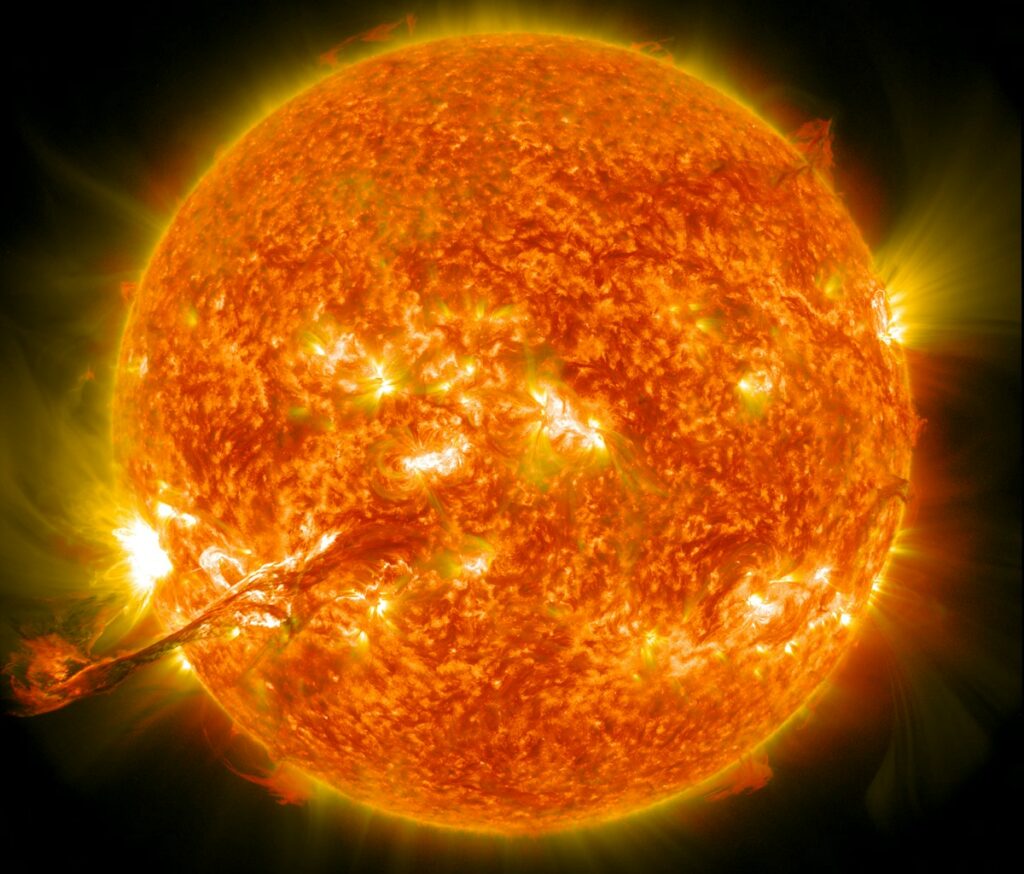
- Earth might not be engulfed by the Sun when it reaches the end of its life cycle in about five billion years, according to new research published in Astronomy & Astrophysics by KU Leuven and France’s CEA Paris-Saclay.
- Researchers calculated that tidal effects are likely weaker than previously thought, meaning Earth might maintain enough distance during the Sun’s giant phases to avoid engulfment.
- Earth and Mars escape the solar death spiral under the new model.
- This delicate equilibrium between tidal forces and mass loss is crucial, explained Mats Esseldeurs, researcher at KU Leuven’s Institute of Astronomy.
- If tidal forces dominate, Earth will be consumed by the dying Sun. If mass loss prevails, the planet may escape to a wider orbit.
- Long before the Sun’s giant phase begins, Earth’s temperatures will rise so drastically that life will become impossible.
- This doesn’t mean Earth will remain habitable, warned astronomy professor Leen Decin of KU Leuven.
- A study led by astrophysicist Mats Esseldeurs upends 15 years of scientific consensus by showing our planet could escape the solar inferno in roughly five billion years.
- Once the Sun runs out of its hydrogen reserves, it will expand into a red giant, then into a so-called AGB star.
- The energy dissipation is lower than previously thought, said one of the study's co-authors Stéphane Mathis, who works at the CEA Paris-Saclay centre in France.
- A better understanding of tidal physics allows us to say that Earth could move away from the Sun, contrary to what was predicted before, Mathis said.
New research from KU Leuven suggests that Earth may not be engulfed by the Sun when it reaches the end of its life cycle in about five billion years, challenging a long-held scientific consensus.
The study, published in Astronomy & Astrophysics, indicates that the delicate balance between tidal forces and mass loss during the Sun's expansion into a red giant could allow Earth to escape.
Mats Esseldeurs, a researcher at KU Leuven’s Institute of Astronomy, explained, "This is where the fate of Earth becomes dependent on the competition between two effects." If tidal forces dominate, Earth would be consumed; however, if mass loss prevails, the planet may move to a wider orbit.5
The researchers utilized advanced models to show that tidal effects are likely weaker than previously thought, allowing Earth to maintain a safe distance during the Sun's giant phases.
_updates.jpg)
Stéphane Mathis, a co-author of the study, noted, "A better understanding of tidal physics allows us to say that Earth could move away from the Sun, contrary to what was predicted before."11
Despite this potential escape, Leen Decin, an astronomy professor at KU Leuven, cautioned that Earth will not remain habitable, as temperatures will rise drastically long before the Sun's giant phase begins, making life impossible.
The findings suggest that both Earth and Mars could escape the solar death spiral under this new model.3
“A study led by Mats Esseldeurs indicates that tidal forces may be weaker than previously thought, allowing Earth to maintain a safe distance from the sun. However, temperatures will rise drastically long before the sun's giant phase, making life impossible.”
 The Brussels Times
 The News International