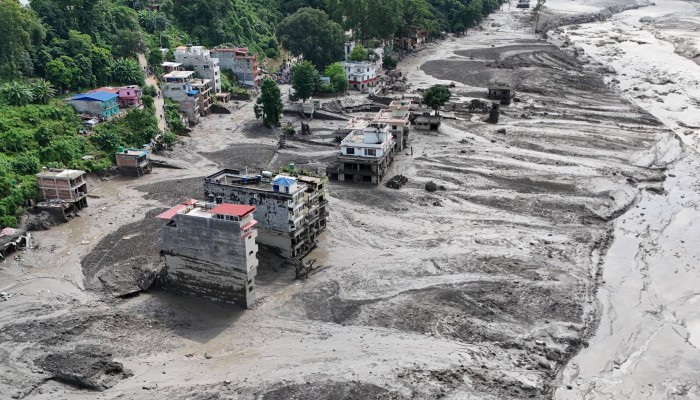
- Deadly flooding along the China-Nepal border has killed more than 600 people and left around 2,500 missing.
- Countries are rapidly building high-altitude infrastructure across the Himalayas, which has raised concerns about growing risks from natural disasters.
- Experts urge state planners to reconsider project design and scale, and to foster regional cooperation on shared risk monitoring systems.
- China leads the infrastructure push, viewing Tibet and its Himalayan borderlands as critical to national and energy security.
- India and Nepal are also investing heavily in the region, which is acutely vulnerable to earthquakes, natural hazards, and climate change.
- China is building massive ultra-high-voltage power transmission lines to carry clean energy from Tibetan hydropower and renewable farms to its eastern seaboard.
Deadly flooding along the China-Nepal border has claimed over 600 lives and left around 2,500 missing, underscoring the increasing risks of natural disasters in the Himalayas as infrastructure development accelerates.146
The disaster, triggered by a glacier collapse that caused a landslide, has devastated communities, destroying buildings, roads, and hydropower stations.
"We’re getting ‘100 year floods’ every five to 10 years… the climate risks are evolving faster than our ability to shift the margins on what we think are the horizons of safety," said Austin Lord, a senior fellow at the Stimson Center.
The rapid infrastructure boom, driven by China, India, and Nepal, aims to harness the region's hydropower potential but raises concerns about vulnerability to natural hazards and climate change.
“With so many unknowns, if we don’t start working on them together then we won’t make any progress, and we’ll just be overwhelmed again next time,” Lord added.
Experts emphasize the need for regional cooperation in risk monitoring to mitigate future disasters, as the current situation reveals the inadequacies in planning and response to such catastrophic events.3
Beijing's ambitious projects, including ultra-high-voltage power lines, aim to transform Tibet into a green energy hub, but the implications for safety and environmental stability remain a pressing concern.
The recent floods serve as a stark reminder of the urgent need for comprehensive risk assessment and collaborative strategies in the face of escalating climate threats.
“The disaster left around 2,500 missing on both sides of the border, with no indication it was linked to manmade development. China leads the push, building ultra-high-voltage power lines to carry Tibetan clean energy to its eastern seaboard, while India and Nepal also invest heavily.”