- NASA's Lunar Reconnaissance Orbiter photographed the impact site nearly a week after the Falcon 9 upper stage struck the Moon at about 5,400 mph, revealing a fresh crater and distinctive ejecta patterns.
- A SpaceX rocket hit the Moon on August 5, leading to a significant impact that was captured by NASA's imaging systems.
- NASA said it worked alongside the Korea AeroSpace Administration (KASA) and used the preliminary data that Danuri gathered to guide a narrow-angle camera on board NASA’s Lunar Reconnaissance Orbiter, and capture clearer images.
- Though the rocket collision was unplanned, NASA researchers said the event did not pose a threat to anyone on Earth or to the lunar surface.
- This is not something we’re really concerned about. This is actually a technically accepted and safe method of disposing of hardware in low lunar orbit, NASA lunar scientist Kelsey Young said in a posted to social media.
- The European Southern Observatory’s Very Large Telescope, located at the Paranal Observatory in Chile, was among the first to detect the impact.
- NASA's Center for Near Earth Object Studies refined the rocket stage's trajectory to determine where it would hit the Moon.
- Capturing the images required precise coordination because of the LRO's orbit and the Moon's rotation.
NASA's Lunar Reconnaissance Orbiter captured images of a 60-foot (18-meter) crater formed by a SpaceX Falcon 9 upper stage that crashed into the Moon on August 5. The rocket, which had been drifting in space for over a year, struck at approximately 5,400 mph (8,700 kph).124
NASA collaborated with the Korea Aerospace Administration (KASA) to refine the trajectory of the rocket and ensure accurate imaging. The LRO had to wait six days for the impact site to come into view, capturing the crater and ejecta patterns from about 60 miles (96 km) above the lunar surface.
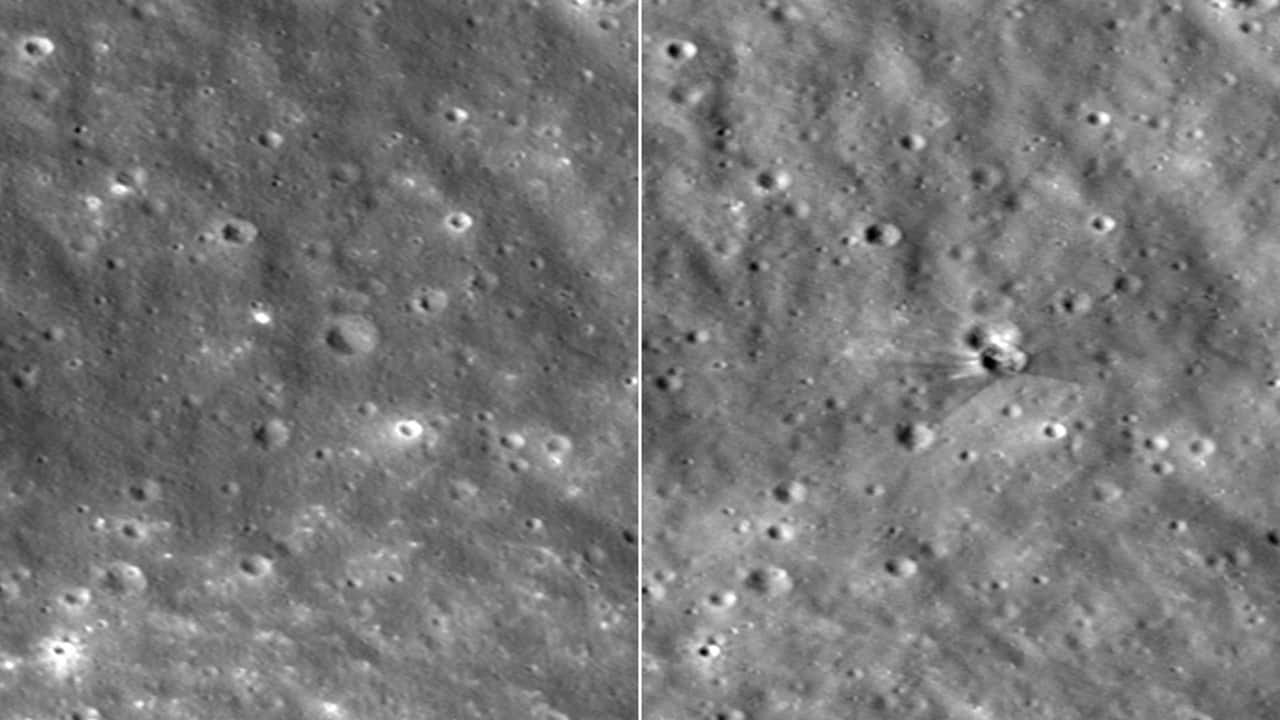
NASA lunar scientist Kelsey Young stated, "This is not something we’re really concerned about. This is actually a technically accepted and safe method of disposing of hardware in low lunar orbit." The crater is estimated to be less than 10 feet (3 meters) deep, based on shadow analysis from the LRO imagery. The event, while unplanned, did not pose any risk to Earth or the Moon's surface, according to NASA researchers.6
The European Southern Observatory's Very Large Telescope was among the first to detect the impact, highlighting the collaborative efforts in monitoring space activities.
“NASA collaborated with the Korea AeroSpace Administration to capture clearer images of the impact site, which was detected by the European Southern Observatory's Very Large Telescope. Despite the unplanned collision, NASA stated it posed no threat to Earth or the lunar surface, with a lunar scientist noting it is a safe method of disposing of hardware.”