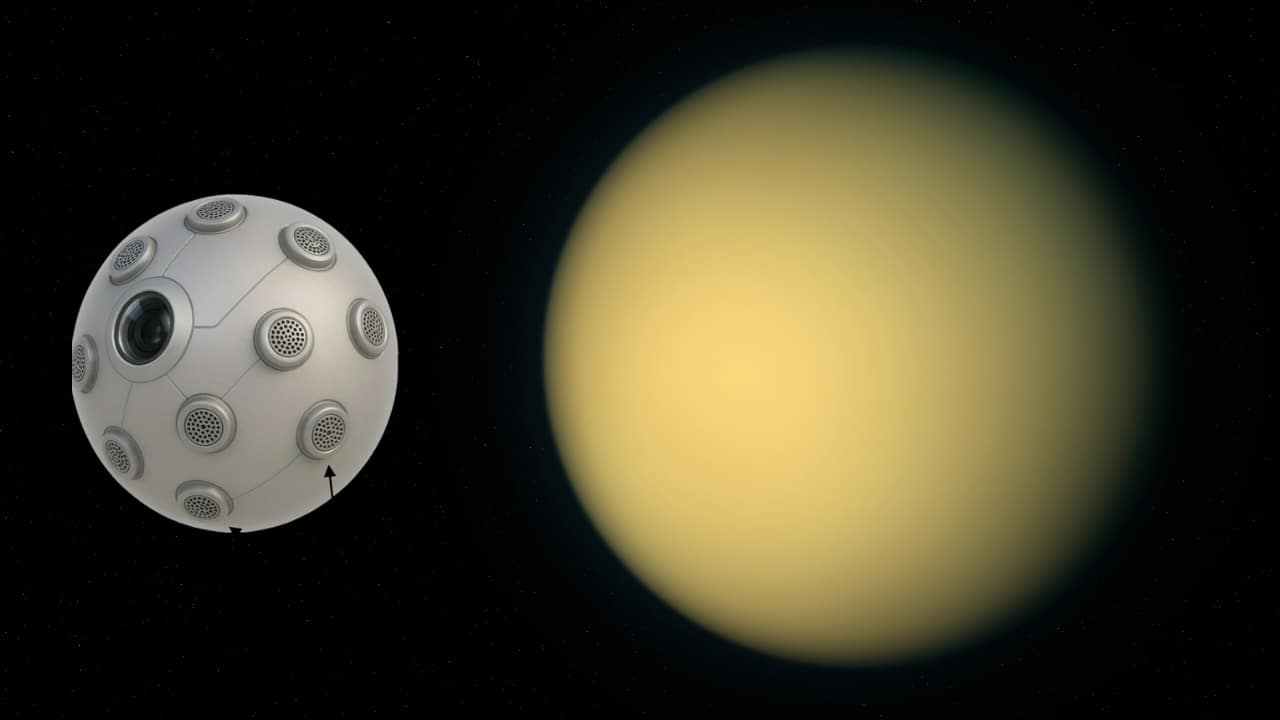
- NASA is funding the development of small, lighter-than-air "aerobots" equipped with solid-state atmospheric ion thrusters designed to swarm and navigate the unexplored, subterranean cave networks of Saturn's largest moon, Titan.
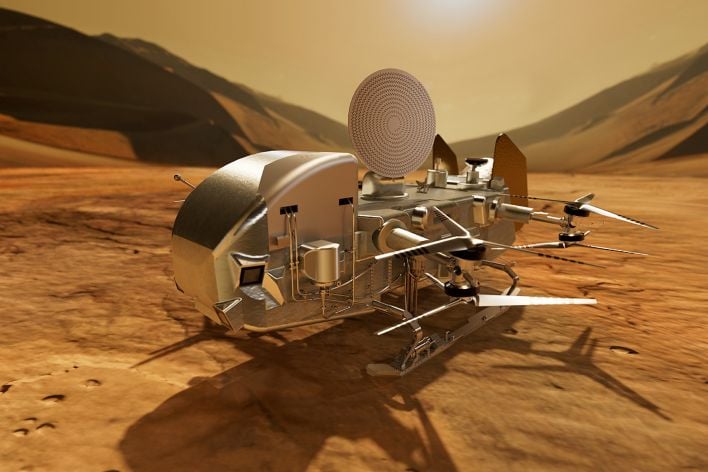
- Selected as part of the 2026 NASA Innovative Advanced Concepts (NIAC) program awards, the aerobots are envisioned as companion tools in outer solar system exploration: while surface vehicles like the upcoming Dragonfly rotorcraft are built to explore Titan's surface, the moon's mysterious subsurface caves and sinkholes, i.e. karst terrain, remain entirely out of reach except for something like these lighter-than-air robots.
- Spherical in shape, these autonomous aerobots are meant to deploy from a main lander or carrier spacecraft, navigating tight underground passages using EHD thrusters placed around its body.
- During the nine-month Phase 1 NIAC study, Drew and his team, including engineers from NASA's Jet Propulsion Laboratory and the Blue Marble Space Institute of Science, are conducting feasibility tests and numerical modeling to prove EHD performance in Titan-like conditions.
- If successful, the concept could advance to a Phase 2 flying prototype.
- Drew estimates that EHD propulsion could operate over 100 times more efficiently on Titan than on a higher-gravity location like Earth, offering twice the thrust-to-power benefit of traditional rotorcraft while generating virtually no turbulent downwash.
- This minimal air disturbance is critical for preserving potentially delicate, scientifically valuable organic deposits on cave walls and floor sediment.
NASA is advancing exploration of Titan's subterranean caves with its SPARK project, which focuses on spherical aerobots utilizing electrohydrodynamic (EHD) thrusters. These thrusters, which operate silently without moving parts, are designed to navigate Titan's dense atmosphere and low gravity, offering a significant efficiency boost.1
The project, led by Daniel Drew from the University of Hawaii at Mānoa, aims to deploy these aerobots from a main lander to explore the unexplored karst terrain of Titan. Traditional rotorcraft are ill-suited for this environment due to the risk of freezing components and turbulent downwash, which can disturb delicate organic deposits.
Drew highlights that EHD propulsion could achieve over 100 times the efficiency on Titan compared to Earth, providing a crucial advantage for scientific exploration. The aerobots will be tested during a nine-month Phase 1 NIAC study, which includes feasibility tests and numerical modeling to simulate Titan-like conditions. If successful, the project could progress to a Phase 2 prototype.46
This innovative approach not only enhances our understanding of Titan's geology but also sets the stage for future missions to other celestial bodies with similar atmospheric conditions, such as Venus.
The SPARK project represents a significant leap in planetary exploration technology, potentially revolutionizing how we study distant worlds.
“The aerobots, selected under the 2026 NIAC program, are designed to deploy from a lander and navigate tight passages using solid-state thrusters, with minimal air disturbance to preserve delicate organic deposits. The nine-month Phase 1 study, involving JPL and Blue Marble Space Institute, could lead to a Phase 2 flying prototype.”