- A partial eclipse, where the moon appears to take a bite out of the sun, occurred over the northern United States, Canada, much of Europe and northwestern Africa.
- The moon completely covers the sun in a photo taken from an observatory in Arcos de las Salinas, Spain, on Wednesday, August 12.
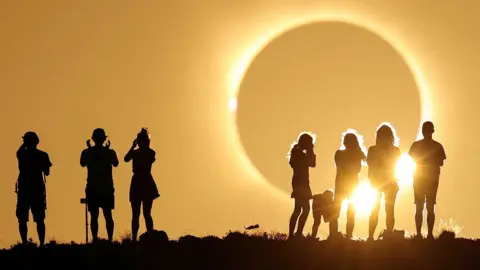
- The diamond ring effect is seen just before the moment of totality in Lodoso, Spain.
- The International Space Station is silhouetted against the sun in a photo taken near Hodgdon, Maine.
- Those in Spain enjoyed a rare sunset eclipse and watched a crescent sunset afterward.
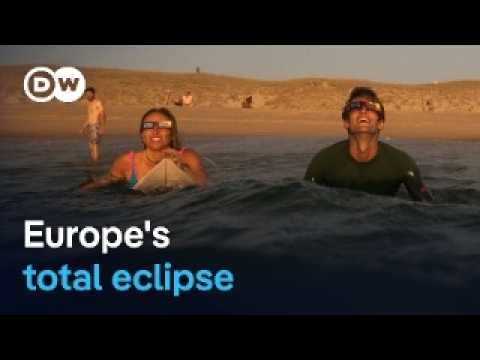
Millions across Europe witnessed a historic solar eclipse on Wednesday, August 12, with totality visible in Spain, where the moon completely covered the sun for about two minutes.235
People in Greenland, Iceland, northern Russia, and a small portion of Portugal also experienced this celestial event.
In Spain, spectators enjoyed a rare sunset eclipse, followed by a crescent sunset, creating a stunning visual spectacle.
Meanwhile, a partial eclipse was observed across the northern United States, Canada, much of Europe, and northwestern Africa, where the moon appeared to take a “bite” out of the sun.1
The event was marked by breathtaking images, including the diamond ring effect captured just before totality in Lodoso, Spain, and the International Space Station silhouetted against the sun near Hodgdon, Maine.4
This phenomenon occurs when the moon moves between the sun and Earth, casting a shadow that blocks the sun’s light from certain areas, creating a moment of darkness during the day.
“The diamond ring effect was captured just before totality in Lodoso, Spain, while the International Space Station was silhouetted against the sun near Hodgdon, Maine. Spain also enjoyed a rare sunset eclipse, with a crescent sunset visible afterward.”