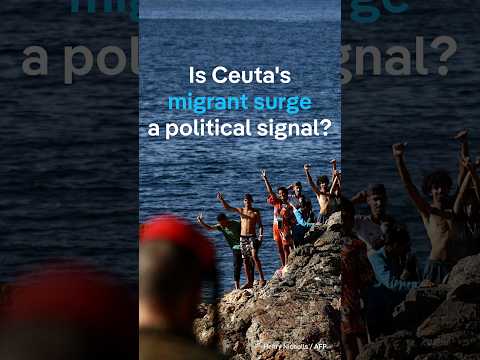
- Thousands of migrants entered Ceuta from neighbouring Morocco on July 31, bringing renewed attention to one of Europe’s most unusual borders.
- Although Ceuta lies on the northern coast of Africa and is surrounded by Moroccan territory, it is administered by Spain and forms part of the European Union (EU).
- Together with nearby Melilla, it forms the EU’s only land border with Africa, making both cities recurring flashpoints for migration and diplomatic tensions between Madrid and Rabat.
Thousands of migrants entered the Spanish city of Ceuta from Morocco on July 31, reigniting focus on the complex dynamics at Europe’s only land border with Africa.1
Ceuta and Melilla, both administered by Spain, are integral to the EU's migration policies and relations with Morocco.
Spain maintains that Ceuta and Melilla are integral parts of the country and that their status is not negotiable, despite Morocco's claims based on historical ties and geographical proximity.
The recent influx of migrants is reminiscent of the 2021 crisis, when tensions escalated after Spain allowed Brahim Ghali, leader of the Polisario Front, to receive medical treatment.
Spain accused Morocco of easing border controls during the crisis, while Moroccan officials denied the suggestion that they should act as Europe’s border guard.
The European Union views these enclaves as critical to discussions on migration and border security, especially as they face ongoing pressures from migration and sovereignty disputes.
Migration experts cite misinformation and smuggling networks as factors influencing the latest surge, alongside a recent court ruling affecting Spain's border policies.
As long as these issues persist, Ceuta and Melilla will remain among the Mediterranean’s most sensitive border flashpoints.
“Thousands of migrants made the crossing on July 31, highlighting Ceuta's unusual status as an African city administered by Spain and surrounded by Moroccan territory. Along with Melilla, Ceuta forms the EU's only land border with Africa, a recurring source of diplomatic tension between Madrid and Rabat.”