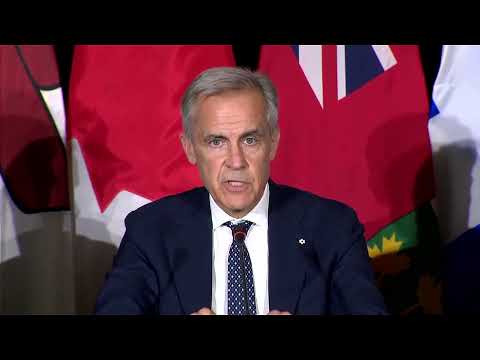
- Council of the Federation summer meeting concluded on July 23 in Charlottetown, Prince Edward Island.
- Prime Minister Mark Carney and Premier Susan Holt are considering retaliatory measures against U.S. tariffs.
- Holt suggested leveraging New Brunswick energy exports to New England in response to the trade war.
- Carney stated that everything's on the table regarding negotiations with the U.S. on tariffs.
- Ontario Premier Doug Ford advocated for using potash and oil as leverage against the U.S.
- Alberta Premier Danielle Smith and Saskatchewan Premier Scott Moe rejected the idea of withholding shipments of oil and potash.
- Northwest Territories Premier R.J. Simpson was appointed as the new Chair of the Council.
Maritime provinces' leaders are exploring the use of electricity sales as leverage in response to U.S. tariffs. At a recent meeting in Charlottetown, Prime Minister Mark Carney indicated that retaliatory measures are on the table if negotiations with President Trump fail.2
“Everything’s on the table depending on the outcome of the negotiations,” Carney stated, emphasizing the need for a comprehensive agreement addressing existing tariffs on Canadian industries such as softwood lumber and steel.
New Brunswick Premier Susan Holt echoed this sentiment, suggesting that the province's energy exports to New England could be utilized as a bargaining chip.
“We know that we have those kinds of tools at our disposal should we need them,” Holt remarked, highlighting the significance of energy in the trade dynamics.

Ontario Premier Doug Ford also weighed in, advocating for the use of Canada’s energy resources as leverage, stating, “They need to feel the pain rather than us constantly feeling the pain.”5
However, not all provincial leaders agree; Alberta Premier Danielle Smith and Saskatchewan Premier Scott Moe have rejected the idea of withholding oil and potash shipments, asserting that “that’s not going to happen.”6
As tensions rise, the Maritime provinces are poised to navigate a complex trade landscape, balancing cooperation and competition in their electricity systems while addressing the looming threat of U.S. tariffs.
“Holt said New Brunswick supplies energy to New England, calling it 'tools at our disposal' and hinted the province could sell elsewhere, while Ford advocated using potash and oil as leverage but Smith and Moe rejected withholding shipments. Carney said 'everything's on the table' and stressed any deal must address existing tariffs on softwood lumber, steel, aluminum, and autos.”